Gemini Enterprise Exam Prep: Generative AI Leader Study Guide and Practice Questions
-
 Mohit
- 13 Oct, 2026
- Updated 27 Oct, 2026

If you’ve searched for a Gemini Enterprise exam question and landed here, you’re probably preparing for one of two things: the knowledge checks in Google’s Gemini Enterprise courses, or the Google Cloud Certified Generative AI Leader exam, where Gemini Enterprise is a core topic.
This guide covers both. You’ll get the official exam facts, the product name changes that trip people up, the Gemini Enterprise concepts you need to understand, 15 original practice questions with explanations, and a two-week study plan built on free resources.
Table of contents
Open Table of contents
- The 30-second summary
- Which “Gemini Enterprise exam” are you preparing for?
- Generative AI Leader exam at a glance
- Exam sections and where Gemini Enterprise fits
- The name changes you must know
- Gemini Enterprise concepts the exam tests
- 15 practice questions
- A two-week study plan
- Exam-day tips
- Wrapping up
The 30-second summary
- There is no standalone Gemini Enterprise certification. Gemini Enterprise is tested inside the Generative AI Leader exam.
- The exam: $99, 90 minutes, 50–60 multiple-choice questions, no prerequisites, valid for 3 years.
- The biggest section (~35%) covers Google Cloud’s gen AI offerings, and that’s where Gemini Enterprise lives.
- Product names changed. The current exam guide uses Agent Platform, Agent Search, and Agent Studio. The word “Vertex” doesn’t appear.
- Free prep exists: the Google Skills learning path, official sample questions, and Gemini Enterprise skill badges through the GEAR program.
Which “Gemini Enterprise exam” are you preparing for?
People use “Gemini Enterprise exam” for two different things, and the way you prepare differs.
| Course knowledge checks and skill badges | Generative AI Leader certification | |
|---|---|---|
| What it is | Quizzes and challenge labs inside Google Skills courses | A proctored Google Cloud certification exam |
| Gemini Enterprise coverage | The whole course is about Gemini Enterprise | One major topic within a broader gen AI exam |
| Examples | Introduction to Gemini Enterprise (2 h 15 min), Create Your First Gemini Enterprise Application skill badge (about 1 h) | Generative AI Leader exam |
| What you earn | A skill badge | A Google Cloud certification valid for 3 years |
| Cost | Available through Google Skills; GEAR members get monthly learning credits at no cost | $99 plus tax |
If you’re working through a course quiz, the concepts section and practice questions below cover the same ground. If you’re going for the certification, read the whole guide.
Generative AI Leader exam at a glance
These are the official exam details from Google Cloud’s certification page.
| Detail | Value |
|---|---|
| Length | 90 minutes |
| Format | 50–60 multiple-choice questions |
| Registration fee | $99 (plus tax where applicable) |
| Languages | English, Japanese, Spanish, Portuguese |
| Delivery | Online-proctored or onsite-proctored at a test center |
| Prerequisites | None |
| Intended audience | Anyone in any job role, with or without hands-on technical experience |
| Validity | 3 years |
This is a business-level exam. It asks you to pick the right approach or product for a scenario, not to write code or configure infrastructure.
Exam sections and where Gemini Enterprise fits
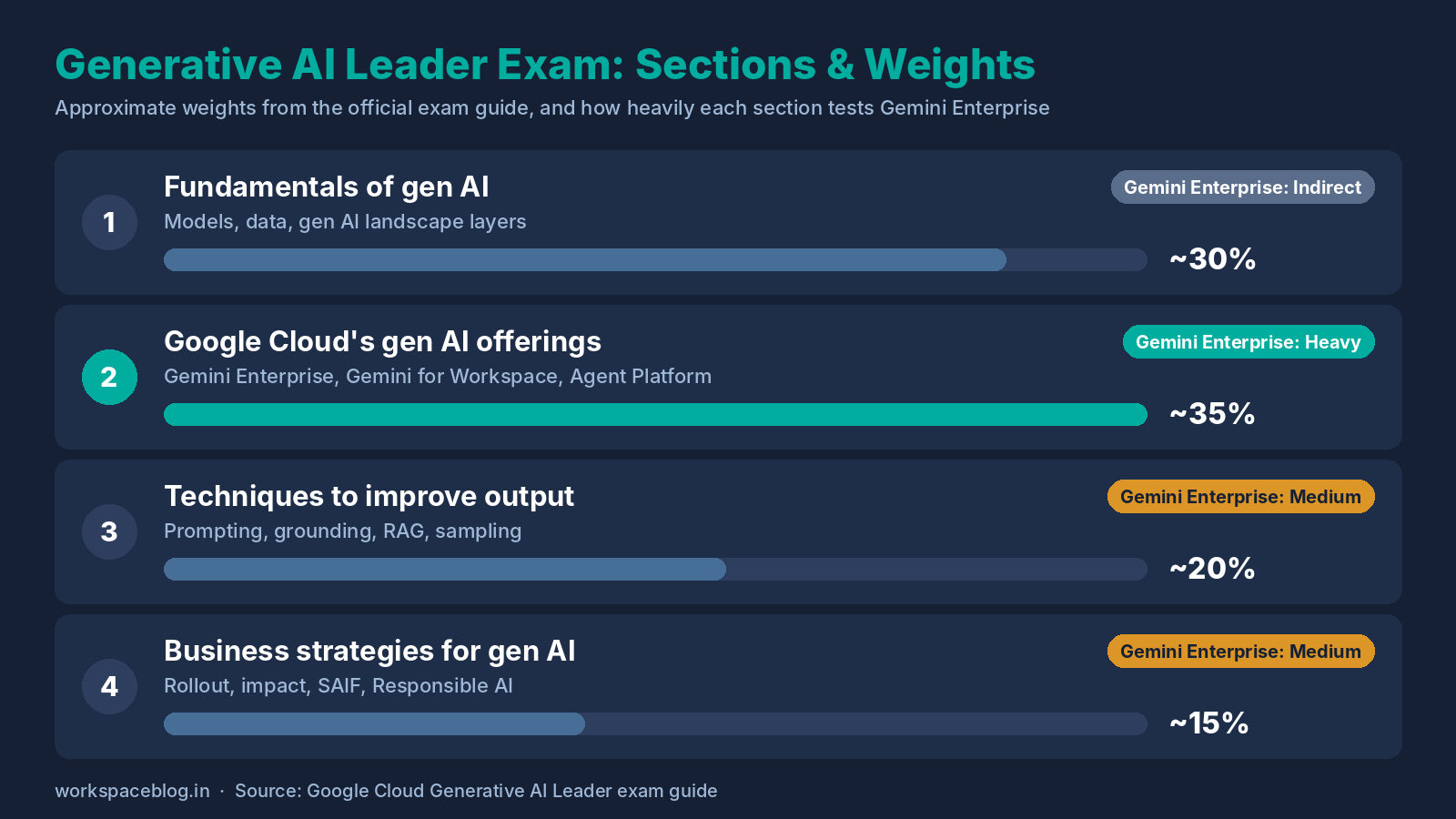
The exam guide splits the exam into four sections. The weights are approximate.
| Section | Weight | What it covers | Gemini Enterprise relevance |
|---|---|---|---|
| 1. Fundamentals of gen AI | ~30% | AI/ML terminology, foundation and multimodal models, data quality, the layers of the gen AI landscape, Google’s models (Gemini, Gemma, Imagen, Veo) | Indirect: you need the vocabulary |
| 2. Google Cloud’s gen AI offerings | ~35% | Prebuilt offerings (Gemini app, Gemini Enterprise, Gemini for Google Workspace), customer experience tools, Agent Platform, agent tooling | Direct and heavy |
| 3. Techniques to improve model output | ~20% | Limitations and mitigations, prompt engineering, grounding and RAG, sampling settings | Medium: grounding is how Gemini Enterprise works |
| 4. Business strategies for gen AI | ~15% | Choosing and integrating solutions, measuring impact, the Secure AI Framework (SAIF), Responsible AI | Medium: rollout and security scenarios |
In section 2, the guide asks you to understand Gemini Enterprise’s functionality, use cases, and business value, including multimodal search, custom agents, and notebook capabilities. Expect scenario questions where Gemini Enterprise is one of four plausible-looking product choices.
The name changes you must know
Google renamed a lot of products in 2025 and 2026, and the certification page notes that the exam “was recently updated to reflect branding changes.” Older study material, practice tests, and forum posts often use the old names. Here’s how to translate them.
| You may see (older material) | Name on the current exam guide | Notes |
|---|---|---|
| Vertex AI | Gemini Enterprise Agent Platform (or “Agent Platform”) | Google introduced Agent Platform in April 2026 as the evolution of Vertex AI |
| Vertex AI Search | Agent Search | Google’s prebuilt search and RAG offering on Agent Platform |
| Vertex AI Studio | Agent Studio | The exam asks when to use Agent Studio vs. Google AI Studio |
| Google Agentspace | Gemini Enterprise | Agentspace became Gemini Enterprise in late 2025 |
| NotebookLM | Gemini Notebook | Renamed in July 2026 |
| Agent Designer (in Gemini Enterprise) | Workflow Builder | Renamed on September 3, 2026; the exam guide may still describe it generically as a no-code agent designer |
If a practice question mentions a product you can’t find in the current exam guide, it’s probably an old name. Map it to the new one before you answer.
Gemini Enterprise concepts the exam tests
You don’t need admin-level detail for the exam, but you do need a clear picture of what Gemini Enterprise is for and how it handles data. For the full platform walkthrough, see our Gemini Enterprise Agent Platform guide.
Its primary purpose
Gemini Enterprise gives employees one place to search company knowledge, chat with an assistant grounded in that knowledge, and use AI agents that act on it. It connects to sources like Gmail, Google Drive, Jira, Confluence, SharePoint, and Salesforce, so people don’t have to search each system separately.
When a question asks for the “primary purpose” of Gemini Enterprise, the answer is about centralized, permission-aware access to company data through AI search, assistants, and agents. It isn’t a cybersecurity product, a data warehouse, or a customer-facing chatbot.
Permission-aware search
This is the most common admin worry, and the exam tests it. Gemini Enterprise enforces the access permissions from the source system. If a user can’t open a file in Google Drive or an issue in Jira, that content won’t appear in their search results or in the assistant’s answers, even though it’s indexed.
Connecting a shared drive doesn’t expose private, unshared documents to everyone. Users only see what they could already open.
Connectors and data stores
Each connected source feeds one or more data stores, and the assistant answers from those stores. Some connectors also support actions: the assistant can create a calendar event or update a ticket for the user, not just read data.
Three ways to get agents
| Approach | Who uses it | Typical use |
|---|---|---|
| Prebuilt agents (e.g. Deep Research) | Everyone | Ready-made research and analysis |
| No-code Workflow Builder (formerly Agent Designer) | Business users and analysts | Simple task agents built without code |
| Full-code agents (e.g. Agent Development Kit) | Developers | Complex, multi-step agents with custom tools |
A common question pattern describes a user’s skill level and asks which approach fits. Non-technical user means no-code; complex custom logic means full-code.
Gemini Enterprise vs. Gemini for Google Workspace vs. the Gemini app
| Product | What it does |
|---|---|
| Gemini app | General-purpose AI assistant (Gems, now being replaced by skills, customize it) |
| Gemini for Google Workspace | AI built into Gmail, Docs, Sheets, Meet, and the other Workspace apps |
| Gemini Enterprise | Company-wide AI search, assistant, and agents across many data sources, including non-Google systems |
Gemini for Workspace helps you inside a Google Workspace app. Gemini Enterprise works across your organization’s systems. For the Workspace side, see our Gemini for Google Workspace guide.
The security model
Know these facts for security questions:
- Customer data is encrypted, and access is controlled through identity and access management (IAM) plus the source system’s permissions.
- Customer data isn’t shared with third-party developers or added to public datasets.
- Enterprise controls such as VPC Service Controls and customer-managed encryption keys (CMEK) are available for stricter requirements.
- Google’s Secure AI Framework (SAIF) is the framework the exam expects you to know for securing AI across its lifecycle.
Grounding
Gemini Enterprise answers from your company’s data rather than only from what the model learned in training. That’s grounding, and when the model retrieves documents before answering, it’s retrieval-augmented generation (RAG). If a scenario says the model gives outdated or made-up answers about internal policy, grounding on enterprise data is usually the fix.
15 practice questions
These questions are original and written to match the style and topics of the exam guide. They aren’t copied from any real exam. Try each one before you open the answer.
1. A company wants employees to search Google Drive, Jira, and SharePoint from one place, see only what they’re allowed to see, and use AI agents to act on the results. Which offering fits best?
- A) The Gemini app
- B) Gemini Enterprise
- C) Gemini for Google Workspace
- D) Google AI Studio
Show answer
B) Gemini Enterprise. It’s built for permission-aware search and agents across many enterprise data sources, including non-Google systems. Gemini for Workspace works inside Workspace apps, the Gemini app is a general assistant, and AI Studio is a developer tool.
2. An administrator worries that connecting a shared drive to Gemini Enterprise will let everyone read private, unshared documents. What actually happens?
- A) Gemini Enterprise only indexes files that are shared publicly
- B) All indexed files become readable by every licensed user
- C) Users only see results they already have permission to open in the source system
- D) Admins must manually tag each file before it’s searchable
Show answer
C. Gemini Enterprise enforces the source system’s permissions at query time. Content is indexed, but it only appears for users who already have access to it.
3. An internal assistant gives confident but outdated answers about the company’s travel policy. Which technique most directly fixes this?
- A) Increase the temperature setting
- B) Ground the model on the company’s current policy documents
- C) Fine-tune the model on public internet data
- D) Switch to zero-shot prompting
Show answer
B) Grounding (often through RAG) makes the model answer from current company documents. A higher temperature adds randomness, public data won’t contain the company’s policy, and zero-shot prompting doesn’t add knowledge.
4. Which of these is a prebuilt gen AI offering aimed at end users rather than developers?
- A) Model Garden
- B) Agent Development Kit
- C) Gemini Enterprise
- D) AutoML
Show answer
C) Gemini Enterprise. The exam guide lists it with the Gemini app and Gemini for Google Workspace as prebuilt offerings. The others are developer tools.
5. A business analyst with no coding experience wants an agent that summarizes the team’s open Jira tickets every Monday. What should they use?
- A) The no-code agent builder in Gemini Enterprise (Workflow Builder)
- B) Agent Development Kit
- C) A custom MCP server
- D) Model Garden
Show answer
A. A simple task agent for a non-technical user is what the no-code builder is for. ADK and custom MCP servers need developers.
6. An engineering team needs a multi-step agent that calls internal APIs with custom logic and full control over the code. What fits best?
- A) A Gem in the Gemini app
- B) Gemini Notebook
- C) The no-code Workflow Builder
- D) A full-code agent built with Agent Development Kit
Show answer
D. Complex, multi-step agents with custom tools call for a full-code approach such as ADK.
7. Which statement about Gemini Enterprise’s security model is true?
- A) Customer data is shared with third-party developers to improve connectors
- B) Customer data is added to publicly accessible datasets
- C) Customer data is encrypted and protected by access controls
- D) Anyone at Google can browse customer data without restriction
Show answer
C. Data is encrypted and governed by IAM and source permissions. The other options describe things enterprise customers are specifically protected against.
8. You include two examples of a correctly formatted incident summary in your prompt before asking the model to write a third. What technique is this?
- A) Zero-shot prompting
- B) Few-shot prompting
- C) Chain-of-thought prompting
- D) ReAct prompting
Show answer
B) Few-shot prompting. Giving a small number of examples is few-shot. Zero-shot means no examples.
9. Which prompting approach has the model alternate between reasoning steps and actions such as tool calls?
- A) Role prompting
- B) Prompt chaining
- C) ReAct
- D) One-shot prompting
Show answer
C) ReAct (“reason and act”) interleaves reasoning with actions, which is how many agents decide when to call a tool.
10. A compliance team wants summaries that are consistent and predictable every time. Which setting change helps most?
- A) Lower the temperature
- B) Raise the temperature
- C) Raise top-p to its maximum
- D) Remove all safety settings
Show answer
A. A lower temperature makes output more deterministic. Raising temperature or top-p increases variety.
11. On the current exam guide, what is the name of Google’s prebuilt search and RAG offering on Agent Platform?
- A) Google Cloud Search
- B) Agentspace
- C) Agent Search
- D) Gemini Notebook
Show answer
C) Agent Search. Older material may describe the same capability with Vertex AI names. Agentspace is the old name for Gemini Enterprise.
12. Which Google framework provides guidance for securing AI systems across their lifecycle?
- A) SAIF (Secure AI Framework)
- B) BeyondCorp
- C) ISO 27001
- D) Zero-shot
Show answer
A) SAIF. The exam guide names SAIF explicitly in the business strategies section.
13. Leadership asks how to show that a Gemini Enterprise rollout is succeeding. Which measure is most meaningful?
- A) The number of connectors configured
- B) The size of the underlying model
- C) Adoption and time saved finding information or completing tasks
- D) The total number of tokens processed
Show answer
C. Impact measurement focuses on business outcomes such as adoption, time saved, and productivity, not technical counts.
14. A team replaces employee names with random IDs so records can still be linked across datasets without showing who they belong to. What is this?
- A) Anonymization
- B) Pseudonymization
- C) Encryption at rest
- D) Fine-tuning
Show answer
B) Pseudonymization. Identifiers are swapped for consistent tokens, so records stay linkable. Anonymization removes identifying information so records can’t be traced back to a person.
15. A team wants a Google model with open weights that it can run on its own infrastructure. Which family fits?
- A) Gemini
- B) Gemma
- C) Imagen
- D) Veo
Show answer
B) Gemma is Google’s family of open models. Imagen generates images and Veo generates video.
A two-week study plan
This plan assumes about an hour a day and uses free resources.
| Days | Focus | Resources |
|---|---|---|
| 1–2 | Read the exam guide end to end; note every product name | Official Generative AI Leader exam guide (PDF) |
| 3–5 | Fundamentals: model types, data, the gen AI landscape layers | Generative AI Leader learning path on Google Skills |
| 6–8 | Google Cloud offerings, with extra time on Gemini Enterprise | Introduction to Gemini Enterprise course; our Agent Platform guide |
| 9 | Hands-on: build a Gemini Enterprise app | Create Your First Gemini Enterprise Application skill badge (about 1 hour) |
| 10–11 | Prompting, grounding, RAG, sampling settings | Learning path modules; practice questions 3 and 8–10 above |
| 12 | Business strategy, SAIF, Responsible AI | Learning path modules; practice questions 12–14 above |
| 13 | Official sample questions; review every wrong answer | Sample questions on the certification page (untimed, unlimited retakes) |
| 14 | Re-read the name-change table and your notes | This guide |
About GEAR: Google’s Gemini Enterprise Agent Ready (GEAR) program is a no-cost membership in the Google Developer Program. Members get monthly learning credits for Google Skills labs, including the Gemini Enterprise skill badges. That’s useful if you want hands-on practice without paying for labs.
Exam-day tips
- Read for the business need first. Most questions describe a scenario. Find what the organization needs (search across systems? AI inside Docs? a custom agent?), then match the product.
- Watch the user’s skill level. “Non-technical analyst” points to no-code; “engineering team with custom APIs” points to full-code.
- Translate old names. If an option uses a name you don’t recognize, check it against the name-change table before ruling it out.
- Grounding beats fine-tuning for fresh internal facts. When the problem is outdated or invented answers about company data, grounding or RAG is usually the intended answer.
- Eliminate the distractors. Options that share customer data publicly or remove access controls are never correct on a security question.
Wrapping up
Gemini Enterprise doesn’t have its own certification, but it’s one of the most heavily tested products on the Generative AI Leader exam. Learn what it’s for, how it enforces permissions, the three ways to build agents, and how it differs from Gemini for Workspace, and you’ll handle most of those questions.
Pair this guide with hands-on time. Building a small Gemini Enterprise app through the skill badge lab makes the concepts concrete. If your organization is evaluating Gemini Enterprise, Google Workspace is the natural foundation, since Gmail, Drive, Chat, and Calendar are among its first data sources.
Official Google documentation:
- Generative AI Leader certification
- Generative AI Leader exam guide (PDF)
- Introduction to Gemini Enterprise (Google Skills)
- Gemini Enterprise Agent Ready (GEAR) program
Related reading:
- Gemini Enterprise Agent Platform: Introduction & Integration: the full platform walkthrough, covering editions, connectors, agents, and security.
- Gemini Enterprise Workspace Add-On: IT Admin Guide: the Workspace add-on tier, CMEK, and audit logging.
- Gemini for Google Workspace: Complete Admin Guide: Gemini inside Gmail, Docs, Meet, and Sheets.
Exam details reflect Google Cloud’s Generative AI Leader certification page and exam guide as of October 2026. Google updates exams and product names regularly, so always check the official certification page before you book.
This guide contains referral or affiliate links. If you sign up through one, Workspace Blog may earn a commission at no extra cost to you. Learn more.
Frequently Asked Questions
- Is there a dedicated Gemini Enterprise certification?
- Not as a standalone proctored exam. Gemini Enterprise is tested inside the Google Cloud Certified Generative AI Leader exam, mainly in the section on Google Cloud's gen AI offerings. Google Skills also offers Gemini Enterprise courses and skill badges, such as Introduction to Gemini Enterprise and Create Your First Gemini Enterprise Application, but those are badges, not certifications.
- How much does the Generative AI Leader exam cost and how long is it?
- The exam costs $99 plus tax where applicable. It lasts 90 minutes and has 50 to 60 multiple-choice questions. You can take it online-proctored or at a test center, in English, Japanese, Spanish, or Portuguese, and the certification is valid for 3 years.
- Does the exam still use Vertex AI product names?
- No. Google updated the exam to reflect its branding changes, and the current exam guide does not use the word Vertex. It refers to Gemini Enterprise Agent Platform (often shortened to Agent Platform), Agent Search, and Agent Studio. Study the current exam guide so the names on exam day are familiar.
- Do I need technical experience to pass the Generative AI Leader exam?
- No. Google lists no prerequisites and says the certification is for anyone in any job role, with or without hands-on technical experience. The exam tests whether you can match business needs to the right gen AI approach and Google product, not whether you can write code.
- What is the best free way to prepare for Gemini Enterprise questions?
- Work through the Generative AI Leader learning path on Google Skills, take the official sample questions, and complete the Introduction to Gemini Enterprise course. If you want hands-on practice, the Create Your First Gemini Enterprise Application skill badge takes about an hour. The GEAR program gives members monthly learning credits for these labs at no cost.