Gemini 4 Argon Benchmarks Explained: Where It Leads, Where It Trails, and What It Means for IT
-
 Mohit
- 20 Oct, 2026

Every new frontier model arrives with a wall of benchmark numbers, and Gemini 4 Argon is no exception. Google’s model card lists 19 results across knowledge work, coding, science, long context, computer use, images and video, and security, compared against GPT-6 Astra, Claude Fable 5.1 and Claude Opus 5.5.
This guide puts the full table in one place, explains what each benchmark actually tests, and shows where Argon leads and where it does not. It ends with what the numbers mean if you are deciding which model your teams should use in Gemini Enterprise, the Gemini API or the Gemini features in Google Workspace.
Key Takeaways
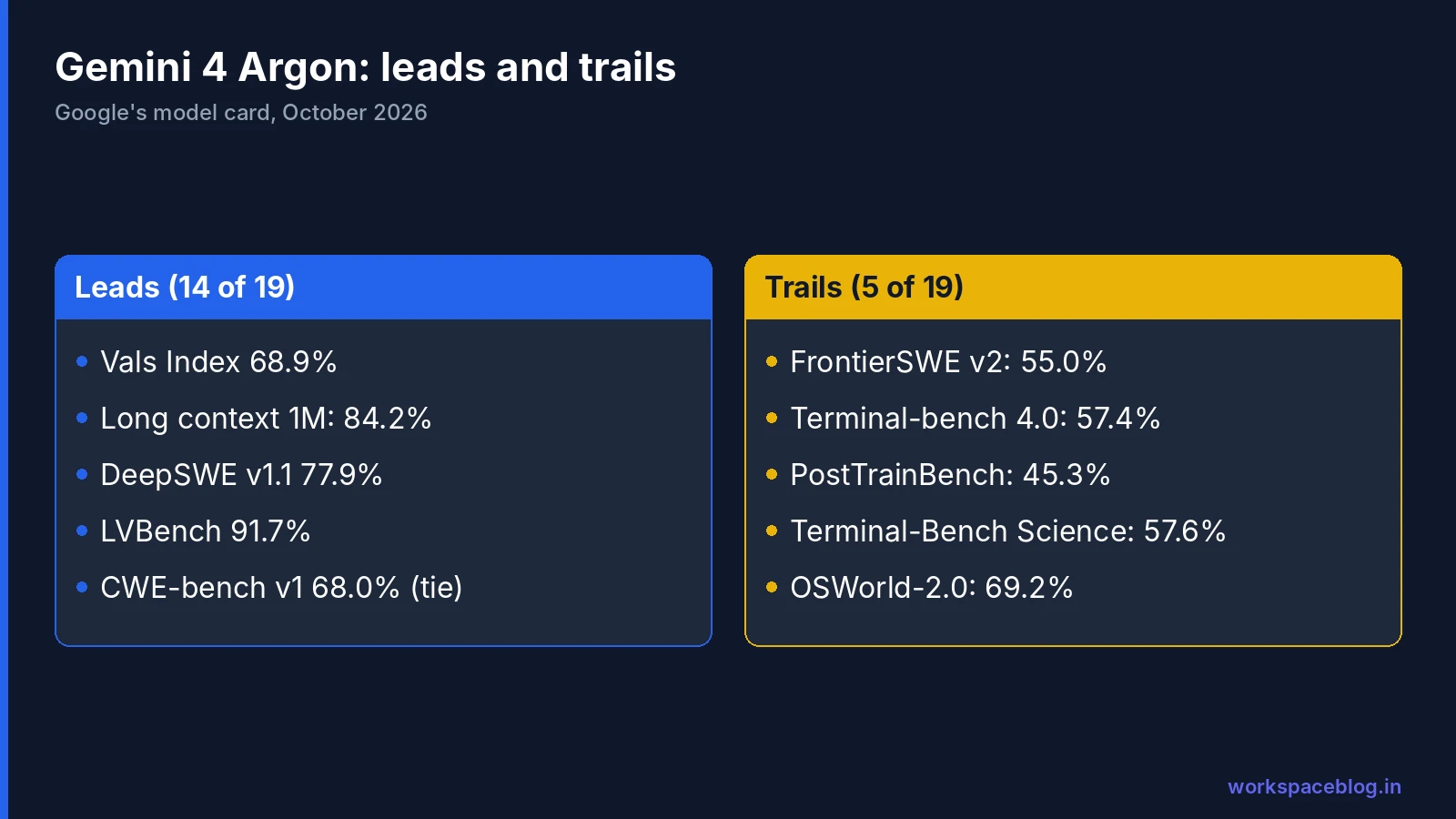
- Argon has the top score on 14 of 19 results in Google’s table, including one tie.
- It leads clearly on knowledge work (Vals Index 68.9%, Harvey’s Legal Agent Benchmark 19.6%) and long context (84.2% on GraphWalks from 256k to 1M tokens).
- It trails on five: FrontierSWE v2, Terminal-bench 4.0, PostTrainBench, Terminal-Bench Science and OSWorld-2.0.
- All results are reported by Google as of October 2026, so treat them as a guide, not proof.
- For your own decision, run a small evaluation on your own tasks before switching teams to a new default model.
Table of contents
Open Table of contents
The Full Results Table
These are the results published on Google DeepMind’s Gemini 4 Argon model card. The highest score in each row is in bold.
| Area | Benchmark | Gemini 4 Argon | GPT-6 Astra | Claude Fable 5.1 | Claude Opus 5.5 |
|---|---|---|---|---|---|
| Knowledge work | Vals Index | 68.9% | 63.1% | 65.8% | 67.0% |
| Knowledge work | AutomationBench | 51.3% | 41.4% | 31.4% | 42.5% |
| Knowledge work | Vals Finance Agent v2 | 65.4% | 53.5% | 58.9% | 58.6% |
| Knowledge work | Harvey’s Legal Agent Benchmark | 19.6% | 5.4% | 6.7% | 3.8% |
| Agentic coding | DeepSWE v1.1 | 77.9% | 74.1% | 67.4% | 74.2% |
| Agentic coding | FrontierSWE v2 | 55.0% | 65.5% | 56.3% | 62.3% |
| Agentic coding | Vibe Code Bench | 91.9% | 89.6% | 90.3% | 90.3% |
| Agentic coding | Terminal-bench 4.0 | 57.4% | 58.2% | 57.9% | 66.4% |
| ML engineering | PostTrainBench | 45.3% | 44.3% | 40.2% | 49.3% |
| Science and math | Terminal-Bench Science 0.1 | 57.6% | 68.1% | 52.6% | 63.3% |
| Science and math | LABBench 2 | 88.8% | 85.4% | 68.6% | 73.1% |
| Science and math | RiemannBench | 76.0% | 72.0% | 65.6% | 69.6% |
| Long context | GraphWalks, up to 128k (F1) | 99.7% | 98.7% | 91.4% | 90.6% |
| Long context | GraphWalks, 256k to 1M (F1) | 84.2% | 71.8% | 65.0% | 66.8% |
| Computer use | Agent’s Last Exam (pass rate) | 39.5% | 34.2% | Not reported | 38.2% |
| Computer use | OSWorld-2.0 (offline subset) | 69.2% | 72.6% | Not reported | Not reported |
| Images and charts | Chartography | 71.6% | 71.0% | 46.2% | 66.3% |
| Video | LVBench | 91.7% | 87.5% | 79.7% | 83.7% |
| Cybersecurity | CWE-bench v1 | 68.0% | 68.0% | 58.0% | 67.0% |
Google also reports two results outside this table: 87% on ERQA, an embodied reasoning benchmark for robotics, and a 0.7% attack success rate on Gray Swan’s indirect prompt injection benchmark across 15 adaptive attempts, where lower is better.
What the Benchmarks Measure
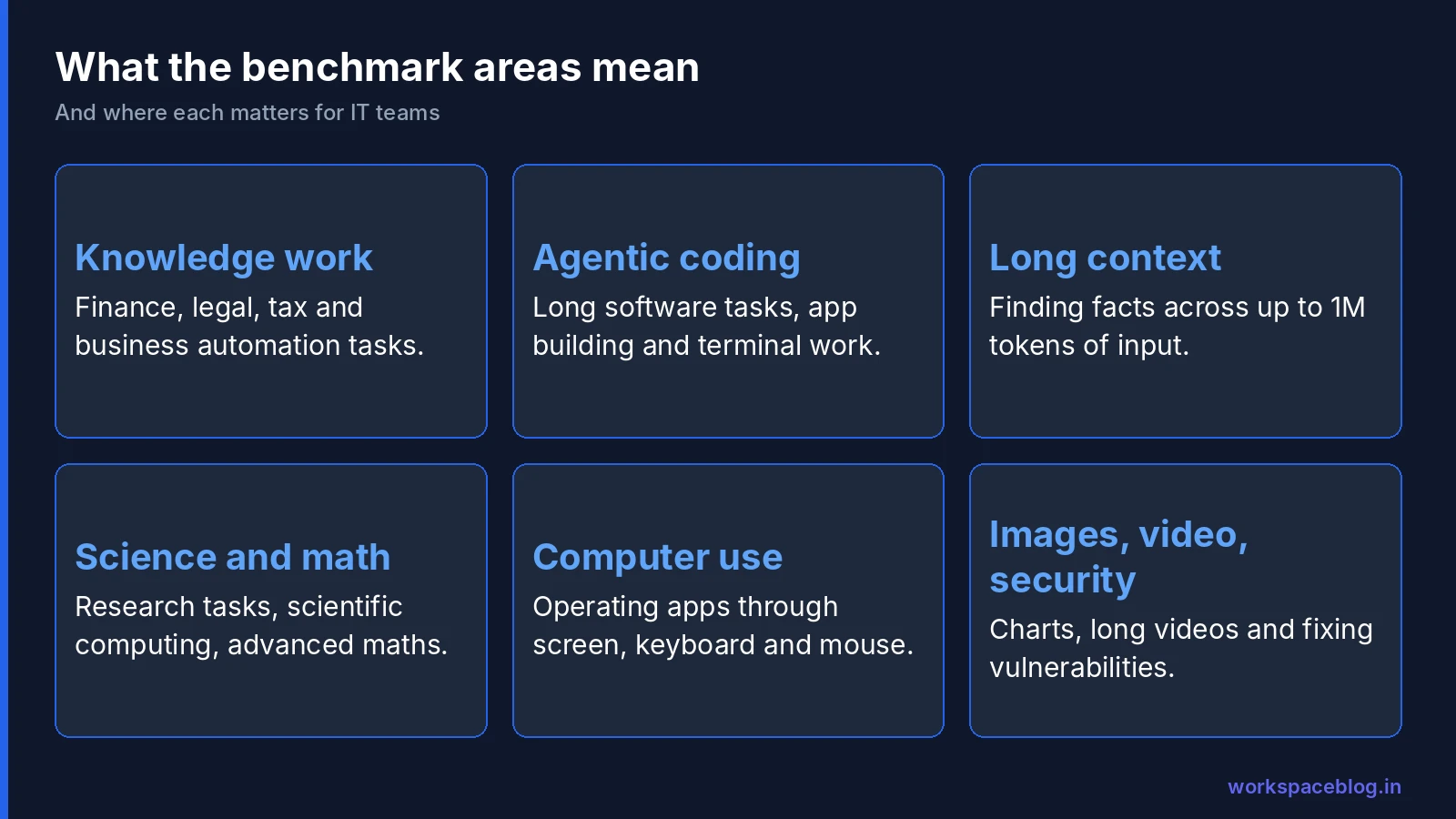
A score only matters if you know what was tested. Here is each group in plain terms.
Knowledge work
- Vals Index: tasks across finance, coding, legal and tax work, weighted by each sector’s contribution to US GDP. It is the closest thing in the table to “general office work”.
- AutomationBench (Zapier): end-to-end execution of tasks across core business functions, such as moving data between apps.
- Vals Finance Agent v2: multi-step financial research.
- Harvey’s Legal Agent Benchmark: legal research and drafting. The low absolute scores show how hard the test is; the gap between models is what stands out.
Agentic coding and ML engineering
- DeepSWE v1.1: long, real-world software engineering tasks.
- FrontierSWE v2: harder frontier-level engineering problems.
- Vibe Code Bench: building working apps from loose descriptions.
- Terminal-bench 4.0: completing tasks in a command-line environment.
- PostTrainBench: machine learning engineering work on model training.
Science, long context and multimodal
- LABBench 2 and Terminal-Bench Science 0.1: biology research tasks and scientific computing.
- RiemannBench: advanced mathematics.
- GraphWalks: following connections through very long inputs, scored with F1. The 256k to 1M row tests the far end of Argon’s 1,048,576-token context window.
- Chartography: reading charts. LVBench: understanding long videos.
Computer use and security
- Agent’s Last Exam and OSWorld-2.0: operating a computer through its screen, keyboard and mouse.
- CWE-bench v1: fixing real software vulnerabilities.
Where Argon Leads
Knowledge work is Argon’s strongest area and the most relevant to most organisations. It is first on all four knowledge-work rows, with the widest margin on Harvey’s legal benchmark (19.6% against 6.7% for the next model) and AutomationBench (51.3% against 42.5%).
Long context is the second standout. Every model does well up to 128k tokens, but from 256k to 1M tokens Argon scores 84.2% while the next best is 71.8%. That matters for work over long contracts, large codebases or months of email.
Images, video and long-running coding complete the picture: first on LVBench, Chartography, DeepSWE and Vibe Code Bench.
Google also points to results from early users. ServiceNow saw about 20% better task success than Gemini 3.8 Flash on its own NowAI-Bench, and Google says its Antigravity engineering teams increased agentic code submissions by more than 35% while cutting rollbacks by nearly a third.
Where Argon Trails
Argon is not first everywhere, and the gaps tell you where to test carefully:
| Benchmark | Argon | Leader | Gap |
|---|---|---|---|
| FrontierSWE v2 | 55.0% | GPT-6 Astra, 65.5% | 10.5 points |
| Terminal-Bench Science 0.1 | 57.6% | GPT-6 Astra, 68.1% | 10.5 points |
| Terminal-bench 4.0 | 57.4% | Claude Opus 5.5, 66.4% | 9.0 points |
| PostTrainBench | 45.3% | Claude Opus 5.5, 49.3% | 4.0 points |
| OSWorld-2.0 | 69.2% | GPT-6 Astra, 72.6% | 3.4 points |
The pattern is clear: the hardest terminal-based and frontier engineering tasks are still contested. If your developers work mostly in the terminal, compare models on your own repositories before standardising. Our comparison of Jules, Antigravity, Claude Code and Codex covers the coding tools that run these models.
How to Read Vendor Benchmarks
A few rules keep benchmark tables in perspective:
- The publisher picks the tests. These results come from Google. Other vendors publish tables where their own models look best.
- Settings matter. Thinking level, tools and the number of attempts change scores. Google publishes its evaluation methodology for Argon, and it is worth reading before comparing numbers from different sources.
- Small gaps are noise. A one or two point difference rarely shows up in day-to-day use.
- Your work is not a benchmark. A model that leads on legal research may not be the best at your support tickets.
What This Means for IT Teams
If you run Gemini Enterprise or approve which models developers may use:
| Situation | What to do |
|---|---|
| Gemini Enterprise users | The Argon toggle defaults to on in the Gemini Enterprise apps from October 27, 2026. Check the setting and decide whether to pilot it first. Our Gemini 4 Argon guide lists the settings. |
| Document-heavy teams (legal, finance, HR) | The knowledge-work and long-context results make Argon a strong first candidate. Pilot with real documents. |
| Developer teams | Test on your own codebase, especially terminal-heavy work where other models lead. |
| Cost owners | Argon’s API price is $2 / $10 per million input / output tokens until November 30, 2026, then $4 / $20. Check how Gemini Enterprise usage is billed. |
Run your own evaluation
You do not need a research team to check a model against your own work:
- Collect 20 to 50 real tasks from one team, with the answer a good employee would give.
- Run them through two or three candidate models with the same instructions.
- Score the answers blind, or use the evaluation service in Gemini Enterprise Agent Platform to score them automatically.
- Compare quality, speed and cost per task, then decide.
Conclusion
On Google’s published numbers, Gemini 4 Argon is the strongest model in its comparison for knowledge work, very long documents, and video and chart understanding, and competitive almost everywhere else. It is not the leader on the hardest terminal and frontier engineering tasks, where GPT-6 Astra and Claude Opus 5.5 still score higher.
Use the table to choose what to test first, not what to buy. A short evaluation on your own tasks will tell you more than any leaderboard, whether your teams use Argon through Gemini Enterprise, the API or the Gemini features in Google Workspace.
Official sources:
- Gemini 4 Argon model card (Google DeepMind)
- Gemini 4 Argon: our next era of frontier intelligence
- Gemini 4 Argon available on Google Cloud
- Gemini 4 Argon for Robotics
- Gemini 4 Argon on Gemini Enterprise Agent Platform
Related reading:
- Gemini 4 Argon: What IT Admins Need to Know: availability, pricing and admin settings.
- Jules vs Antigravity vs Claude Code vs OpenAI Codex: the coding agents that run these models.
- Gemini Enterprise Pay-as-you-go and Overages: how model usage is billed.
This guide contains referral or affiliate links. If you sign up through one, Workspace Blog may earn a commission at no extra cost to you. Learn more.
Frequently Asked Questions
- How does Gemini 4 Argon score on benchmarks?
- In the results table on Google DeepMind's model card, Gemini 4 Argon has the top score on 14 of the 19 rows, including the Vals Index (68.9%), DeepSWE v1.1 (77.9%), AutomationBench (51.3%), LVBench (91.7%) and long-context GraphWalks (99.7% up to 128k tokens and 84.2% from 256k to 1M). It ties GPT-6 Astra on CWE-bench v1 at 68.0%.
- Where does Gemini 4 Argon trail other models?
- On five rows of Google's table another model scores higher: FrontierSWE v2 and Terminal-Bench Science 0.1 (GPT-6 Astra), Terminal-bench 4.0 and PostTrainBench (Claude Opus 5.5), and OSWorld-2.0 for computer use (GPT-6 Astra).
- Which models is Gemini 4 Argon compared with?
- Google's model card compares Gemini 4 Argon with GPT-6 Astra, Claude Fable 5.1 and Claude Opus 5.5. All results are reported by Google as of October 2026.
- Are the Gemini 4 Argon benchmark results independent?
- No. The results are published by Google, with some benchmarks run by partners such as Vals, Zapier and Harvey. They are a useful guide, but the safest way to choose a model is to run your own evaluation on your own tasks, for example with the evaluation service in Gemini Enterprise Agent Platform.
- What is the Gemini 4 Argon score on ERQA?
- Google's robotics announcement for Gemini 4 Argon reports 87% on ERQA, an embodied reasoning benchmark, using pure reasoning. ERQA is not part of the main results table on the model card.