Gemini 4 Argon: What IT Admins Need to Know About Google's New Frontier Model
-
 Mohit
- 15 Oct, 2026
- Updated 26 Oct, 2026

Google’s naming has changed with this release. After a long run of Gemini 3.x models, the first Gemini 4 model is not called “Gemini 4 Pro” but Gemini 4 Argon. Google announced it on September 30, 2026 and opened access across its consumer, developer, and enterprise products on October 13. If your organization uses Gemini Enterprise, the Gemini API, or Google Workspace with Gemini, this model is already reaching your users, in some places automatically.
This guide covers what Argon is good at, the published benchmarks and specifications, pricing, where it is available today, and the admin settings to review now that its toggle defaults to on in Gemini Enterprise from October 27.
Key Takeaways
- Gemini 4 Argon is Google’s new frontier model for coding, enterprise knowledge work, and cyber defence.
- 1,048,576-token context, text output, and up to 1M output tokens with long decode.
- API pricing is $2 / $10 per million tokens until November 30, 2026, then $4 / $20.
- In the Gemini Enterprise apps it launched off by default, and the toggle defaults to on from October 27, 2026.
- In Gemini Enterprise, data residency and ML processing are supported in the us and eu locations.
Table of contents
Open Table of contents
What Gemini 4 Argon Is
Google’s announcement, written by Koray Kavukcuoglu, describes Argon as a frontier model for “real-world coding, enterprise knowledge work, and cyber defense,” designed to keep reasoning reliably across long, multi-step tasks. Three areas stand out:
- Software engineering. Google says its engineers use Argon for debugging, large codebase migrations, and algorithm design. One example: migrating C and C++ libraries to Rust, where the rewritten libgav1 video decoder runs 2.7 times faster than the previous Rust port with identical output.
- Enterprise knowledge work. Google highlights finance, legal, and tax tasks, multi-step financial research, and legal drafting, along with chart analysis and finding details in long videos.
- Cyber defence. Argon can find, validate, and patch software vulnerabilities. For that reason Google first released it to vetted security teams through its Fairwind Program, where it is available without the cyber guardrails that apply to everyone else.
Google Cloud also says Argon powers the Gemini agent announced at Gemini at Work the week before. Our guide to the Gemini agent explains what that agent does.
The Published Benchmarks
All of these are reported by Google or its partners, so treat them as a guide rather than independent proof.
| Benchmark | What it measures | Reported result |
|---|---|---|
| DeepSWE v1.1 | Long-horizon real-world software engineering | 77.9% |
| AutomationBench (Zapier) | Business automation tasks | 51.3%, ranked first |
| LVBench | Long video understanding | 91.7% |
| CWE-bench v1 | Fixing software vulnerabilities | 68%, tied for first |
| Gray Swan indirect prompt injection | Resistance to hidden instructions in content | 0.7% attack success across 15 adaptive attempts |
| ERQA | Embodied reasoning for robotics | 87% |
Google DeepMind’s model card publishes the full results, including the Vals Index (68.9%) and Harvey’s Legal Agent Benchmark (19.6%), where Argon is first, and FrontierSWE v2 and Terminal-bench 4.0, where it trails other frontier models. Our Gemini 4 Argon benchmarks explained guide walks through all 19 rows.
The prompt injection result matters most for admins. Agents that read email, documents, and web pages can be tricked by instructions hidden in that content. A lower attack success rate does not remove the risk, but it is a meaningful improvement for agentic use.
Technical Specifications
From the Gemini API model card, with the architecture and knowledge cutoff from Google DeepMind’s model card:
| Item | Detail |
|---|---|
| Model ID | gemini-4-argon (stable) |
| Architecture | Sparse mixture-of-experts transformer, trained as a new model rather than fine-tuned from an earlier one |
| Knowledge cutoff | March 2026 |
| Inputs | Text, image, video, audio, PDF |
| Output | Text |
| Context window | 1,048,576 tokens, shared by input and output |
| Default maximum output | 65,536 tokens for synchronous requests |
| Long decode output | Up to 1,048,576 tokens |
| Thinking levels | Low, medium, high |
| Tools | Function calling, structured output, code execution, Google Search and Maps grounding, file search, URL context, computer use (preview) |
| Caching | Implicit caching; explicit caching not supported |
| Not supported | Image and audio generation, Live API |
| Processing options | Batch, Flex, and Priority inference |
The long decode option is new. Google’s announcement says the output limit rose to 1M tokens from 64K, which matters for tasks such as generating long reports, large code changes, or full document translations in a single response.
Pricing
Google’s announcement and the Google Cloud blog list the same API prices:
| Through November 30, 2026 | From December 1, 2026 | |
|---|---|---|
| Input, per million tokens | $2 | $4 |
| Output, per million tokens | $10 | $20 |
| Cached input | 95% off the input price | 95% off the input price |
Use inside the Gemini Enterprise apps falls under your Gemini Enterprise licences and their usage quotas. API and Agent Platform usage is billed per token, so set budgets on any project where developers start testing Argon. A Cloud Billing budget with forecast alerts on those projects is the simplest safeguard.
Where It Is Available
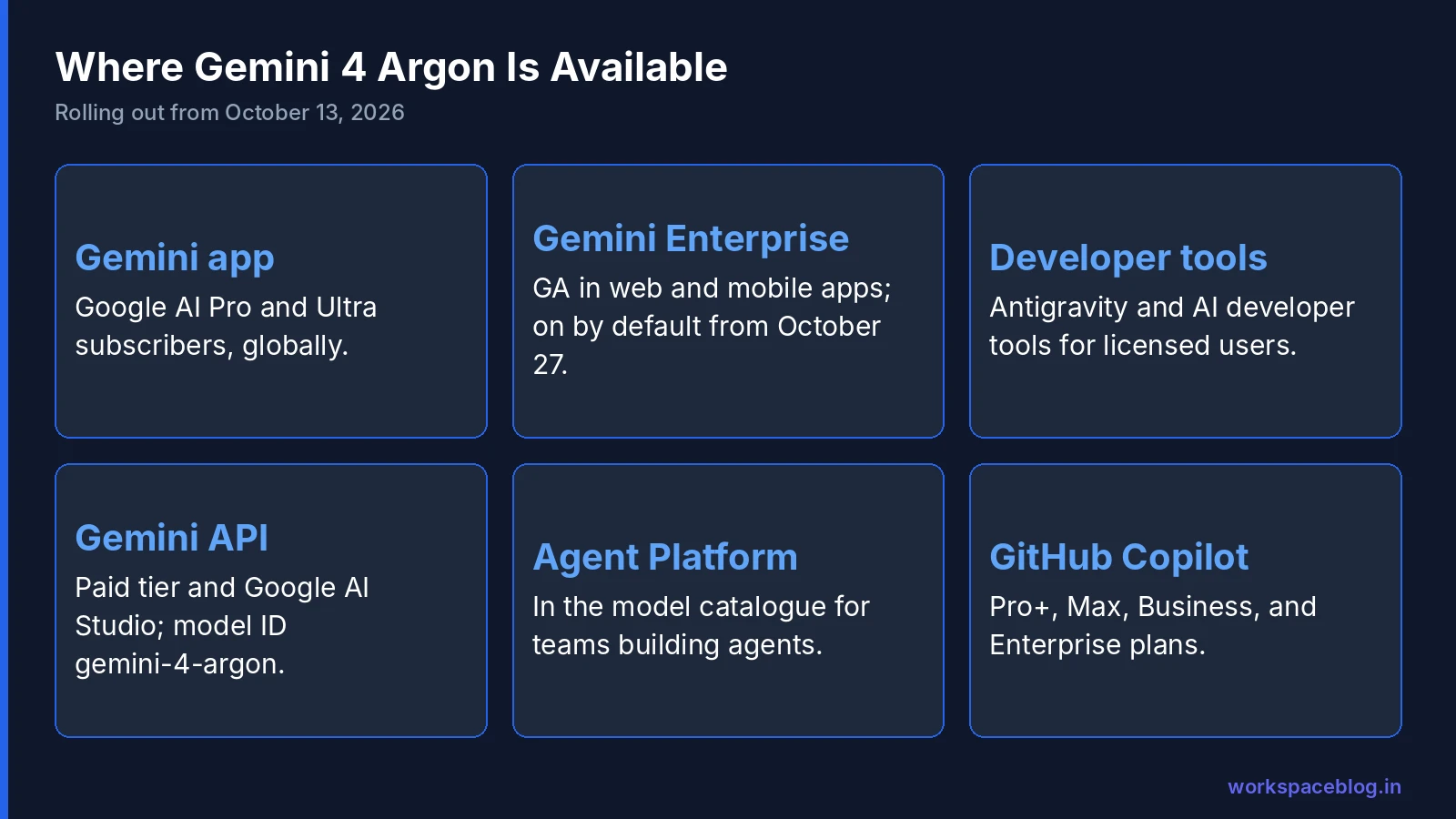
As of October 13, 2026, Google lists these places:
| Product | Who gets it |
|---|---|
| Gemini app (consumer) | Google AI Pro and Ultra subscribers, rolling out globally |
| Gemini Enterprise web and mobile apps | Generally available; launched off by default, toggle defaults to on from October 27, 2026 |
| Gemini Enterprise AI developer tools | On by default when the default authorised model list is used |
| Gemini API and Google AI Studio | Paid tier |
| Google Antigravity | Google AI Ultra subscribers and Gemini Enterprise developer tools users |
| Gemini Enterprise Agent Platform | Available through the platform’s model catalogue |
| AlphaEvolve | Default model for new experiments from October 26, 2026, replacing Gemini 3.8 Flash |
| GitHub Copilot | Pro+, Max, Business, and Enterprise plans, rolling out gradually |
| Google AI Mode in Search | Listed on Google DeepMind’s model card as a distribution channel |
Google DeepMind’s model card lists “Gemini for business” among its channels, but Google’s announcements do not say which Google Workspace editions get Argon in the Gemini app, so check your Admin console and the Workspace release notes before telling users it is there. Our Gemini for Google Workspace guide explains how the Workspace and Gemini Enterprise offerings differ.
What Gemini Enterprise Admins Should Do Now
Argon launched turned off by default in the Gemini Enterprise web and mobile apps, but the toggle defaults to on starting October 27, 2026. If you have not decided yet, check the setting now.
1. Decide whether to enable it now or wait
In the Google Cloud console, open Gemini Enterprise, choose your app, then Configurations > Feature Management. With the Gemini Enterprise Admin role, you can turn on the model selector and set model availability. If you want a pilot first, turn it off for now, enable it for testing, and tell users about the October 27 change.
2. Check your location
The release notes list the global, us, and eu locations, with data residency and ML processing support in us and eu. If your Gemini Enterprise app uses another in-country location, confirm what Argon support means for your data before enabling it.
3. Review AI developer tools
For licensed users of the AI developer tools, Argon is enabled by default when Antigravity authorized models uses the default selection. If your organization uses a custom model list, an administrator must add Gemini 4 Argon manually. Decide which applies to you.
4. Remember Workflow Builder
Since October 14, 2026, the release notes list Argon as generally available in Workflow Builder and workflow agents, in the global, us, and eu locations. It follows the same default as the apps: off at first, with the toggle defaulting to on from October 27, 2026. Updates can take up to a day to reach workflow agents, so review any workflows that should stay on their current model.
5. Update guidance for users
Tell users what Argon is better at, such as long documents, multi-step research, and code, and remind them of your acceptable use policy. If your organization uses Model Armor or other prompt and response screening, confirm it still applies to the new model.
6. Check other tools that offer Argon
GitHub Copilot Business and Enterprise turn new models on automatically unless an admin has disabled default model enablement. If your developers use Copilot, review its model policy too.
Safety and Security Notes
Google’s announcement describes several safeguards: the model is trained to refuse harmful cyber and CBRN requests while supporting legitimate security research, it is monitored for misaligned behaviour, and test environments are isolated before high-risk evaluations. Google says it took part in the US government’s voluntary pre-release model access process.
Google DeepMind’s model card adds the test results behind those claims:
| Automated safety evaluation (vs. Gemini 3.1 Pro) | Change | What it means |
|---|---|---|
| Text to text safety | +1.57 points | Slightly more violations, within Google’s confidence intervals |
| Multilingual safety | -3.16 points | Fewer violations |
| Image to text safety | -9.29 points | Fewer violations |
| Tone | +5.50% | Better |
| Unjustified refusals | -9.60 points | Refuses fewer legitimate requests |
Google notes that it refined these evaluations, so the results are not directly comparable with earlier model cards.
Human red teaming found content safety similar to or better than Gemini 3.1 Pro, with no serious concerns, and the model met Google’s child safety launch thresholds.
Under Google’s Frontier Safety Framework, the card says Google cannot rule out that Argon reaches the critical capability levels for biological uplift and cybersecurity uplift, so it applied safeguards and built safety cases that assess the risk as below those levels. For stealth and situational awareness, the model passed 14 of 15 challenges, so that level also cannot be ruled out and Google carried out a residual risk assessment. It did not reach the levels for harmful manipulation, machine learning research acceleration or automation, or uplift in the chemical, radiological and nuclear domains.
The card also lists the usual limits of large models: Argon can still hallucinate, and it can occasionally be slow or time out on long tasks, so build retries and human review into agent workflows.
From an admin’s point of view, the practical points are:
- Least privilege still matters. A stronger model in an agent with broad permissions is a bigger risk, not a smaller one. Keep agent connectors and data store access tight.
- Prompt injection is reduced, not solved. Keep screening and human approval for actions such as sending email or changing records.
- Logs and audit. Make sure Gemini Enterprise and Agent Platform activity is logged and reviewed as part of your normal security monitoring.
How Argon Fits With Other Gemini Models
Argon arrives alongside the Gemini 3.x family rather than replacing it overnight. Gemini 3.8 Flash, launched in September, is still available everywhere Argon is, although since October 26, 2026 Argon has replaced it as the default for new AlphaEvolve experiments (which then bill at Argon token prices). Faster, cheaper Flash models remain the sensible choice for high-volume, simple tasks. Use Argon where its strengths pay off: long, complex reasoning, large documents and videos, serious coding work, and security analysis.
If you are preparing for Google’s Generative AI Leader certification, expect model selection questions of exactly this kind. Our exam prep guide covers how to approach them.
Conclusion
Gemini 4 Argon is Google’s strongest model so far for long, complex work, with a 1M-token context window, up to 1M output tokens, and leading results on Google’s chosen coding, automation, and security benchmarks. It is already in the Gemini API, Google AI Studio, the consumer Gemini app for paid subscribers, and Gemini Enterprise.
For admins, the date to remember is October 27, 2026, when the Argon toggle defaults to on in the Gemini Enterprise apps. Review your locations, model lists, and user guidance now. If you are planning a wider AI rollout on Google Workspace, our Gemini Enterprise add-on guide explains licensing and deployment.
Official Google sources:
- Gemini 4 Argon: our next era of frontier intelligence
- Gemini 4 Argon available on Google Cloud
- Gemini 4 Argon model card (Google DeepMind)
- Gemini 4 Argon model card (Gemini API)
- Gemini Enterprise release notes
- Gemini 4 Argon in the Gemini app
Related reading:
- Gemini 4 Argon Benchmarks Explained: every published result, row by row.
- Google’s New Gemini Agent: What It Means for Your Organization: the agent Argon powers.
- Gemini Enterprise Workspace Add-On: licensing and deployment.
- Gemini Enterprise Agent Platform: Introduction: where developers build with Argon.
This guide contains referral or affiliate links. If you sign up through one, Workspace Blog may earn a commission at no extra cost to you. Learn more.
Frequently Asked Questions
- What is Gemini 4 Argon?
- Gemini 4 Argon is the first model in Google's Gemini 4 generation, announced on September 30, 2026. Google describes it as its frontier model for real-world coding, enterprise knowledge work, and cyber defence, built to sustain deep reasoning across long, multi-step workflows.
- Is Gemini 4 Argon available in Gemini Enterprise?
- Yes. Google's Gemini Enterprise release notes dated October 13, 2026 list it as generally available in the web app, mobile app, and AI developer tools, in the global, us, and eu locations. In the web and mobile apps it is turned off by default, and the toggle defaults to on starting October 27, 2026.
- How much does Gemini 4 Argon cost through the API?
- Google lists an introductory price of $2 per million input tokens and $10 per million output tokens through November 30, 2026, then $4 and $20. Cached input tokens are 95% cheaper than the input price.
- What is the context window of Gemini 4 Argon?
- The Gemini API model card lists a context window of 1,048,576 tokens shared between input and output. Output is 65,536 tokens by default for synchronous requests and up to 1,048,576 tokens with long decode.
- Can consumers use Gemini 4 Argon in the Gemini app?
- Google started rolling it out globally on October 13, 2026 to Google AI Pro and Ultra subscribers in the Gemini app. Google's announcements do not mention free accounts.