Gemini 4 Hydrogen vs Carbon vs Argon: Which Gemini 4 Model to Use
Gemini 4 Hydrogen vs Carbon vs Argon: where each model runs, free tier, pricing, thinking levels, comparable benchmarks, safety, and which one to pick.

Checked against Google's official documentation.

Google now has three Gemini 4 models, and Gemini 4 Hydrogen is the newest. Released on November 12, 2026, Hydrogen is the fast, efficient one: cheaper than Carbon and Argon, available on the Gemini API free tier, and designed to work on its own or as a sub-agent next to Carbon. This guide compares Gemini 4 Hydrogen with Carbon and Argon on availability, pricing, thinking levels, benchmarks and safety, using only Google’s own pages.
Key Takeaways
- Gemini 4 Hydrogen (
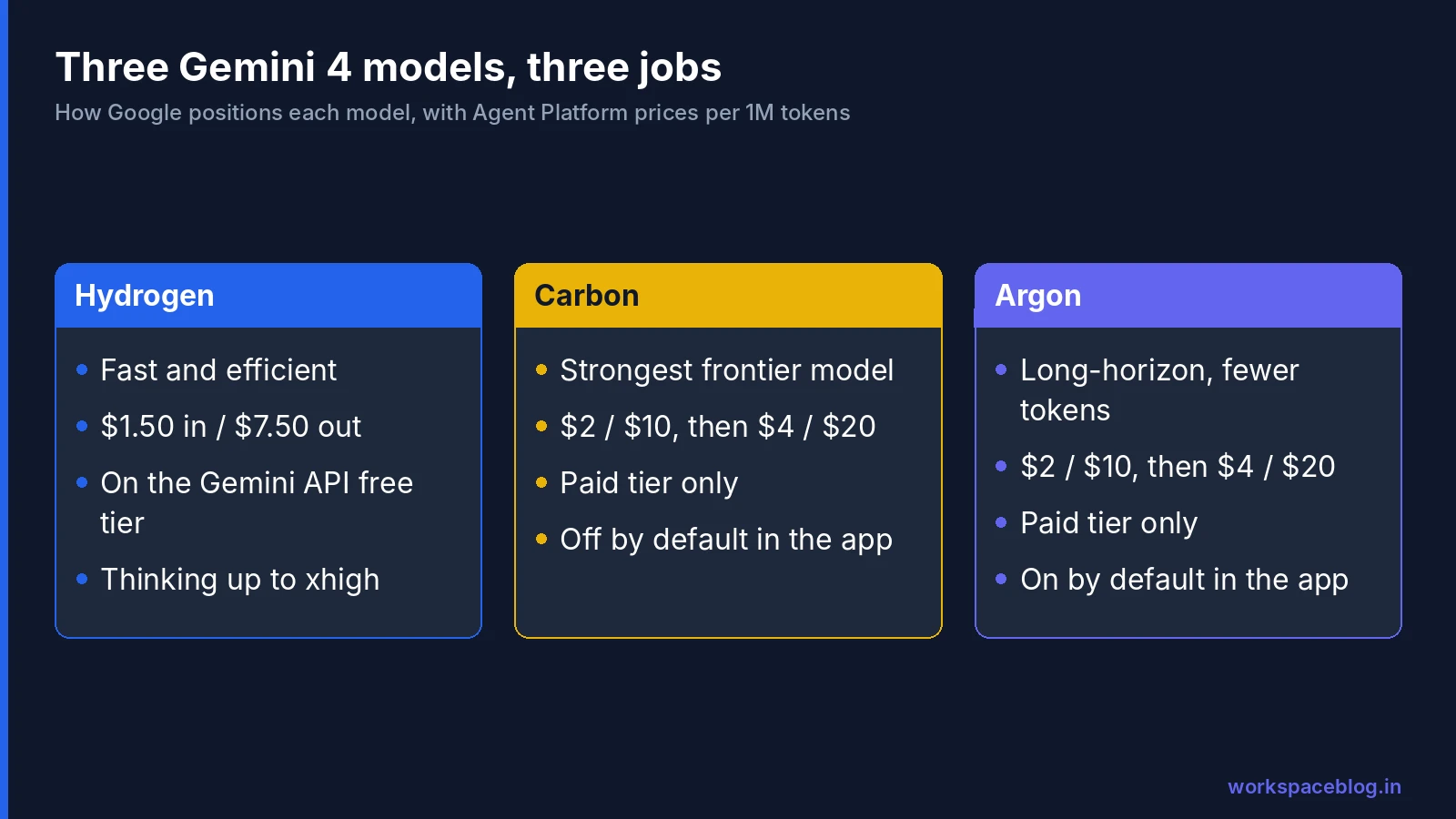
gemini-4-hydrogen) is generally available from November 12, 2026 in the Gemini API, Google AI Studio, Gemini Enterprise and Gemini Enterprise Agent Platform. Google’s model card says it is adapted from Gemini 4 Carbon. - Google positions the three models this way: Carbon is the strongest frontier model, Argon handles advanced long-horizon work with fewer tokens than Carbon, and Hydrogen is the fast, efficient option.
- Hydrogen is the only Gemini 4 model on the Gemini API free tier. Paid, it costs $1.50 / $7.50 per million input / output tokens, against $2 / $10 for Carbon and Argon on Agent Platform until November 30, 2026 and $4 / $20 from December 1.
- Hydrogen adds an xhigh thinking level and defaults to high. Carbon and Argon default to medium and stop at high.
- In Gemini Enterprise, Carbon and Hydrogen are off by default in the web and mobile apps, and on by default in AI developer tools where the default model list is used.
Table of contents
Open Table of contents
The Three Gemini 4 Models at a Glance
| Gemini 4 Hydrogen | Gemini 4 Carbon | Gemini 4 Argon | |
|---|---|---|---|
| Google’s description | Fast and efficient | Strongest frontier model | Advanced long-horizon tasks with lower token use than Carbon |
| Model ID | gemini-4-hydrogen | gemini-4-carbon | gemini-4-argon |
| Context window | 1,048,576 tokens, shared | 1,048,576 tokens, shared | 1,048,576 tokens |
| Output per non-streaming call (Google’s Hydrogen guide) | 65,536 tokens | 32,768 tokens | 32,768 tokens |
| Thinking levels | Low, medium, high (default), xhigh | Low, medium (default), high | Low, medium (default), high |
| Inputs | Text, image, video, audio, PDF | Text, image, audio, video | Text, image, video, audio, PDF |
| Output | Text | Text | Text |
| Knowledge cutoff | March 2026 | March 2026 | March 2026 |
| Gemini API free tier | Yes, rate-limited | No | No |
The output limits come from Google’s “What’s new in Gemini 4 Hydrogen” page, which compares the three directly. All three can extend output to about a million tokens with long decode in the background.
Two developer details matter if you move code from older models. Hydrogen rejects the minimal thinking level with an error, and Google tells developers to remove temperature, top_p and top_k, which are ignored when in range and return a 400 error when out of range. Neither Hydrogen nor Carbon supports explicit context caching. Both use implicit caching on prompts of at least 4,096 tokens, with a 95% discount on cache hits.
Where You Can Use Each Model
| Product | Gemini 4 Hydrogen | Gemini 4 Carbon | Gemini 4 Argon |
|---|---|---|---|
| Gemini API and Google AI Studio | Free and paid tiers | Paid tier | Paid tier |
| Gemini Enterprise Agent Platform | Generally available from November 12, 2026 | Generally available from November 10, 2026 | Generally available |
| Gemini Enterprise web and mobile apps | From November 12, 2026, off by default | From November 10, 2026, off by default | Generally available, on by default from October 27, 2026 |
| Gemini Enterprise Workflow Builder | From November 12, 2026 | From November 10, 2026 | Since October 14, 2026 |
| AI developer tools in Gemini Enterprise (Antigravity) | On by default with the default model list | On by default with the default model list | Available |
| Google Antigravity for individuals | All plans, including Free and Plus (first rolled out to paid Google AI Pro and Ultra) | Google AI Ultra subscribers | Paid Google AI Pro (or a trial on eligible premium devices) and Ultra |
| Google Search and AI Mode | Rolled out globally from November 12, 2026 | - | - |
A few notes on this table:
- Agent Platform calls Hydrogen a short-term release. Google’s Agent Platform release note gives a minimum 45-day notice before it is retired, so pin the model ID in configuration and watch the release notes.
- Antigravity pairs the models. Its Orchestrator option lets Carbon explore and plan in a read-only phase, then hands edits, package updates and tests to Hydrogen, handing back to Carbon if Hydrogen gets stuck. Google reports near-Carbon task success on Terminal-Bench 4.1 with about 24% less quota and about 19% faster completion. Orchestrator with Carbon is for Google AI Ultra; Orchestrator with Argon as planner is for Pro and Ultra.
- Google’s Managed Agents now use Hydrogen. The AI Studio guide says the Antigravity agent in Gemini Managed Agents uses Hydrogen by default, and you can change the model in
agent_config. - The model card lists more places. Google DeepMind’s Hydrogen model card also names the Gemini app and Google Sheets. Google’s pages we checked don’t say which Gemini app plans get it.
Pricing: Gemini 4 Hydrogen vs Carbon vs Argon
On the Gemini API paid tier, Google lists Hydrogen at $1.50 per million input tokens and $7.50 per million output tokens, thinking tokens included, with cached input at $0.075. The free tier costs nothing but is rate-limited.
Agent Platform publishes all three on one page. These are the global endpoint prices per million tokens:
| Model and period | Tier | Input | Cached input | Output |
|---|---|---|---|---|
| Hydrogen | Standard | $1.50 | $0.075 | $7.50 |
| Hydrogen | Batch | $0.75 | $0.0375 | $3.75 |
| Hydrogen | Priority | $2.70 | $0.135 | $13.50 |
| Carbon or Argon, through November 30, 2026 | Standard | $2.00 | $0.10 | $10.00 |
| Carbon or Argon, through November 30, 2026 | Batch | $1.00 | $0.05 | $5.00 |
| Carbon or Argon, through November 30, 2026 | Priority | $3.60 | $0.18 | $18.00 |
| Carbon or Argon, from December 1, 2026 | Standard | $4.00 | $0.20 | $20.00 |
| Carbon or Argon, from December 1, 2026 | Batch | $2.00 | $0.10 | $10.00 |
| Carbon or Argon, from December 1, 2026 | Priority | $7.20 | $0.36 | $36.00 |
Four details change real bills:
- Regional endpoints cost 10% more. For example, Hydrogen Standard is $1.65 input and $8.25 output outside the global endpoint.
- Hydrogen has a cache write price from January 12, 2027. Google lists $1.875 per million tokens on Standard, which is 1.25 times the input price.
- Long outputs are billed even if the request fails. From November 13, 2026, Agent Platform bills completions over 32K tokens even when the request later fails because of a client or server timeout.
- Higher thinking costs more tokens. Hydrogen defaults to high, and Google says xhigh uses the most tokens. Carbon spends more thinking tokens per turn than Argon, by Google’s own description.
From December 1, Hydrogen’s standard price is less than half of Carbon’s and Argon’s. If a task works well on Hydrogen, it is the cheapest of the three to run at volume. For Gemini Enterprise seats, model use draws on the edition’s included quota first; our Gemini Enterprise pay-as-you-go and overages guide explains how usage above quota is billed.
Benchmarks: What Can Actually Be Compared
Google DeepMind publishes two separate tables. The Hydrogen table compares it with Claude Sonnet 5.5 and GPT-6.1 Terra. The Carbon table compares Carbon with Argon, GPT-6 Astra, Claude Opus 5.5 and Claude Fable 5.1. Only five benchmarks appear in both with the same name and notes:
| Benchmark | Gemini 4 Hydrogen | Gemini 4 Carbon | Gemini 4 Argon |
|---|---|---|---|
| Agents’ Last Exam v1.1 (score) | 71.6% | 77.4% | 69.0% |
| Vending-Bench 2 (bank balance) | $14,549 | $16,484 | $13,718 |
| OSWorld-2.1 (offline subset) | 77.6% | 81.5% | 74.7% |
| Chartography | 66.6% | 72.5% | 71.6% |
| SWE-sweep | 13.5% | 9.6% | - |
Read this with care: the numbers come from two tables with their own evaluation write-ups, so treat small gaps as noise. The broad picture is clear, though. Carbon leads Hydrogen on the four knowledge-work, agentic and multimodal rows. Hydrogen beats Argon on three of those four, but not on Chartography. Hydrogen’s best result is SWE-sweep, where it scores 13.5% against Carbon’s 9.6%.
Two pairs look similar but aren’t the same test. The Hydrogen table uses Terminal-Bench 4.1 (cheating-adjusted) and AutomationBench-AA, while the Carbon table uses Terminal-Bench 4.0 (AA) and AutomationBench (Zapier), so we don’t compare those rows.
Hydrogen’s own table
| Area | Benchmark | Gemini 4 Hydrogen | Claude Sonnet 5.5 | GPT-6.1 Terra |
|---|---|---|---|---|
| Agentic coding | SWE-sweep | 13.5% | 3.1% | 5.8% |
| Agentic coding | Terminal-Bench 4.1 (cheating-adjusted) | 57.0% | 63.9% | - |
| Knowledge work | Agents’ Last Exam v1.1 | 71.6% | 60.4% | 69.8% |
| Knowledge work | AutomationBench-AA | 76.1% | 71.8% | 60.2% |
| Knowledge work | Vending-Bench 2 (bank balance) | $14,549 | $11,165 | $9,107 |
| Computer use | OSWorld-2.1 (offline subset) | 77.6% | 83.9% | 74.2% |
| Multimodal | MKA (Climb WSR accuracy) | 53.4% | 52.0% | 43.8% |
| Multimodal | Chartography | 66.6% | 61.6% | 63.2% |
| Science and math | Terminal-Bench-Science 0.1 | 51.4% | 59.9% | 58.3% |
| Reasoning | HLE-Diamond | 58.8% | 53.3% | 47.3% |
The highest score in each row is in bold. Hydrogen leads seven of the ten rows. Claude Sonnet 5.5 leads Terminal-Bench 4.1, OSWorld-2.1 and Terminal-Bench-Science.
Safety: What the Model Card Says
Hydrogen’s model card reports internal results against Gemini 3.8 Flash: text-to-text safety up 0.80 points, multilingual safety up 1.10, image-to-text safety up 7.00, tone down 0.65, and unjustified refusals up 5.57, which Google flags as higher, especially for multimodal prompts.
Under Google’s Frontier Safety Framework, Hydrogen showed no material capability increase over Gemini 4 Argon, so a full set of critical capability evaluations was not required. Google says Hydrogen does not reach the CBRN or cyber critical capability levels but does reach the alert thresholds for both. It did not reach the harmful manipulation or ML R&D levels, and for loss of control Google applied mitigations as if that threshold had been reached, as a precaution. Google lists the full Safety & Security Report for Hydrogen as coming soon.
What Gemini Enterprise Admins Should Review
- Model toggles. Carbon (from November 10) and Hydrogen (from November 12) are off by default in the Gemini Enterprise web and mobile apps. Decide who gets them before users ask.
- Antigravity model lists. Both are on by default in AI developer tools when Antigravity uses Google’s default model selection. If you set a custom authorized models list, add them yourself. Our Google Antigravity in Gemini Enterprise guide covers these settings.
- Locations and residency. Both run in the
global,usandeulocations, with data residency and ML processing inusandeu. If your resource locations policy excludesglobal, check the toggles; our Gemini Enterprise data residency guide explains the rules. - Spend. Since November 13, 2026, single-user quota limits also apply to AI developer tools, so you can stop one developer running xhigh all day from using up the shared pool.
Which Gemini 4 Model Should You Use?
| Workload | Best fit |
|---|---|
| Everyday coding, web apps, quick agent steps | Hydrogen. Fast, cheapest, and Google’s recommended upgrade from Gemini 3.8 Flash |
| Hardest reasoning, long multi-day agent jobs | Carbon. Strongest on every shared benchmark except SWE-sweep |
| Long-horizon work on a budget of tokens | Argon. Google says it uses fewer tokens per turn than Carbon |
| Planner plus workers | Carbon plans, Hydrogen executes. Google suggests Carbon for planning and Hydrogen for code edits, sub-agent tasks and test runs |
| Prototyping on the free tier | Hydrogen. The only Gemini 4 model on the Gemini API free tier |
| High-volume simple tasks | Test Hydrogen at a low thinking level before reaching for a larger model |
Whatever you pick, keep the model ID in configuration, not in code. Hydrogen is a short-term release on Agent Platform, and the Carbon and Argon introductory prices end on November 30, 2026. For the two-model detail, including Carbon’s full benchmark table, see our Gemini 4 Carbon vs Argon comparison.
Conclusion
Gemini 4 now covers three needs. Carbon is the strongest model, Argon is the efficient long-horizon model, and Gemini 4 Hydrogen is the fast, low-cost model that also works as Carbon’s sub-agent. For most teams the practical change is cost: Hydrogen costs $1.50 / $7.50 per million tokens, and from December 1 the other two cost $4 / $20.
If your organisation runs Gemini through Google Workspace and Gemini Enterprise, review the model toggles and Antigravity model lists this week, then run the same 20 to 50 real tasks through Hydrogen and Carbon before you choose a default. Teams still planning their move to Google Workspace can start with our Gemini 4 Argon guide for IT admins for the Gemini Enterprise and Workspace settings around Gemini 4.
Official Google documentation:
- Gemini 4 Hydrogen model card (Google DeepMind)
- Gemini models and benchmark tables (Google DeepMind)
- What’s new in Gemini 4 Hydrogen (Gemini API)
- Gemini 4 Hydrogen model page (Gemini API)
- What’s new in Gemini 4 Carbon (Gemini API)
- Gemini 4 Hydrogen (Gemini Enterprise Agent Platform)
- Agent Platform pricing
- Gemini Developer API pricing
- Gemini Enterprise release notes
- Gemini Enterprise Agent Platform release notes
- Gemini 4 Hydrogen: everyday coding and agentic workflows for developers (Google)
- Google Search gets a major upgrade with Gemini 4 Hydrogen (Google)
- Choose a model (Google Antigravity)
- Gemini 4 Hydrogen and Orchestrator (Google Antigravity)
Related reading:
- Gemini 4 Carbon vs Argon: access, pricing and the full Carbon benchmark table.
- Gemini 4 Argon Benchmarks Explained: every result on the Argon model card.
- Google Antigravity in Gemini Enterprise: AI developer tools, credits and model controls.
- Model Garden: Choosing Gemini, Claude, Gemma, and Open Models: model choice across Agent Platform.
This guide contains referral or affiliate links. If you sign up through one, Workspace Blog may earn a commission at no extra cost to you. Read our referral and advertising disclosure.
Frequently Asked Questions
- What is Gemini 4 Hydrogen?
- Gemini 4 Hydrogen is the fast, efficient member of the Gemini 4 family, released on November 12, 2026. Google's model card says it is adapted from Gemini 4 Carbon and built for everyday coding, agentic work, multimodal knowledge work and running as a sub-agent next to a frontier model. Its model ID is gemini-4-hydrogen.
- Is Gemini 4 Hydrogen free to use?
- In the Gemini API it is on both the free tier, which is rate-limited, and the paid tier. Google lists paid prices of $1.50 per million input tokens and $7.50 per million output tokens, with cached input at $0.075. Carbon and Argon are not on the Gemini API free tier.
- Is Gemini 4 Hydrogen better than Gemini 4 Carbon?
- Not overall. Google calls Carbon its strongest frontier model, and on four of the five benchmarks that appear in both of Google DeepMind's tables, Carbon scores higher than Hydrogen. Hydrogen scores higher than Carbon on SWE-sweep (13.5% against 9.6%), is cheaper, defaults to high thinking and is on the Gemini API free tier.
- Can I use Gemini 4 Hydrogen in Gemini Enterprise?
- Yes. Since November 12, 2026 it is generally available in the Gemini Enterprise web app, mobile app, Workflow Builder and AI developer tools, in the global, us and eu locations. It is off by default in the web and mobile apps, so an admin has to turn it on. In AI developer tools it is on by default where Antigravity uses Google's default model selection.
- What is Gemini 4 Hydrogen's context window?
- 1,048,576 tokens shared by input, thinking and output. A synchronous request returns up to 65,536 output tokens, and long decode in the background can extend output to 1,048,576 tokens minus the input. The knowledge cutoff is March 2026.