Gemini 4 Carbon vs Gemini 4 Argon: Access, Pricing, Benchmarks and Which to Use
Gemini 4 Carbon vs Argon compared: release dates, who can use Carbon now, model IDs, context, pricing, side-by-side benchmarks, safety and which to choose.

Checked against Google's official documentation, last updated 13 Nov, 2026. See what changed

Two weeks after making Gemini 4 Argon generally available, Google announced a second Gemini 4 model: Gemini 4 Carbon. Google calls it its strongest model, and its own benchmark table puts it ahead of Argon on every row. At first only a small group of cyber defenders could use it; since November 10, 2026 it is generally available in Gemini Enterprise and Agent Platform, and Google’s Gemini API guide lists it on the paid tier. If your teams use Gemini Enterprise, the Gemini API or the Gemini features in Google Workspace, the practical question is not which model is stronger, but which one you can actually plan around.
This comparison covers release dates, positioning, who can use each model today and in which products, model IDs, context windows, pricing, the published benchmarks side by side, cybersecurity and long-horizon work, the safety approach, and which model fits which workload. Every figure comes from Google or Google DeepMind. Where Google has not published a detail, this post says so.
Key Takeaways
- Argon is generally available in the Gemini app, the Gemini API, Google AI Studio, Gemini Enterprise and Gemini Enterprise Agent Platform.
- Carbon was announced on October 28, 2026 and became generally available in Gemini Enterprise and Agent Platform on November 10, 2026. Carbon for cyber is still limited to the Fairwind Program allowlist.
- Carbon’s model ID is
gemini-4-carbonwith a 1,048,576-token combined input and output limit. It is on the Gemini API paid tier and in Google AI Studio, but not the free tier. - Google has announced the same introductory price for both: $2 / $10 per million input / output tokens, later $4 / $20.
- On Google DeepMind’s table Carbon beats Argon on all 17 rows, with the biggest jumps in long context, coding and cybersecurity.
Table of contents
Open Table of contents
The Two Models at a Glance
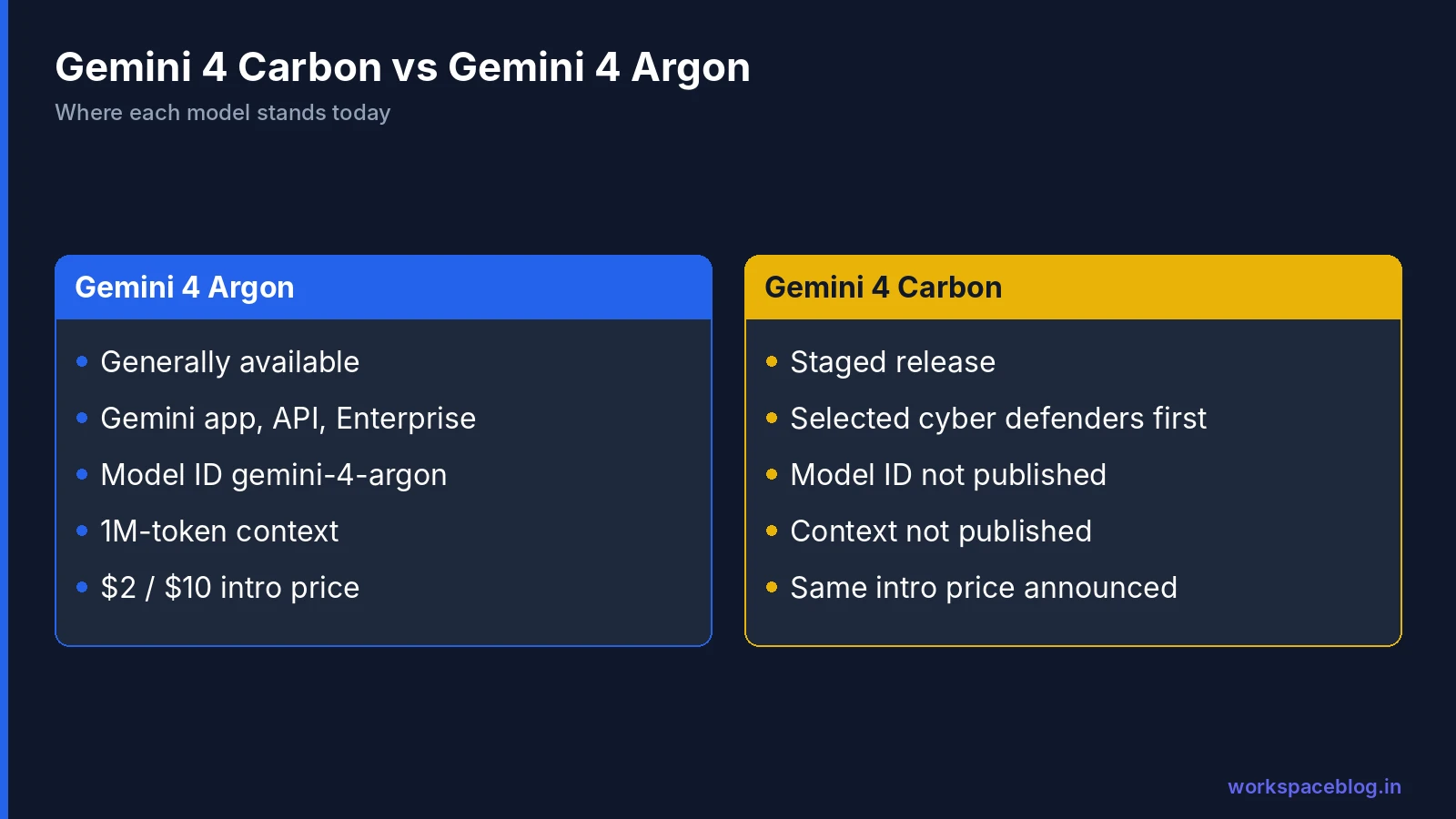
| Gemini 4 Argon | Gemini 4 Carbon | |
|---|---|---|
| Announced | September 30, 2026 | October 28, 2026 |
| Broad access | From October 13, 2026 | Not yet; no date given |
| Google’s positioning | Frontier model for real-world coding, enterprise knowledge work and cyber defence | Strongest model, with state-of-the-art cybersecurity and long-horizon capabilities |
| Who can use it | Paid users across consumer, developer and enterprise products | A subset of cyber defenders, expanding through the Fairwind Program |
| Model ID | gemini-4-argon (stable) | Not published |
| Context window | 1,048,576 tokens, shared by input and output | Not published |
| API price | $2 / $10 per million tokens through November 30, 2026, then $4 / $20 | Same introductory price announced, then $4 / $20 |
| Google DeepMind model card | Published | Not published |
Both announcements were written by Koray Kavukcuoglu at Google DeepMind. On the day Carbon was announced, Sundar Pichai’s Q3 earnings remarks described it as Google’s “strongest frontier model” and said that “Carbon outperforms Argon across almost every domain”.
Release Dates and Positioning
Argon came first. Google announced it on September 30, 2026, initially for vetted security teams, and opened it to consumers, developers and businesses on October 13. Google describes it as built to keep reasoning reliably across long, multi-step tasks, with three headline areas: software engineering, enterprise knowledge work (finance, legal and tax) and cyber defence. Our Gemini 4 Argon guide covers it in full.
Carbon followed on October 28, 2026. Google’s announcement presents it as a step up from Argon rather than a different kind of model, with two areas singled out:
- Cybersecurity. Finding, exploiting and patching vulnerabilities, where Google reports new top scores.
- Long-horizon work. Google says its teams “have seen Carbon run for days to persist through dead ends” on multi-step engineering tasks, such as root-causing and patching subtle bugs across large codebases and low-level systems.
Google also claims improvements across coding, agentic, scientific, full-stack web development and multimodal tasks.
Availability: Who Can Use Carbon Now
Both models are now available, but through different products. Argon is on every Gemini surface. Carbon arrived in Gemini Enterprise on November 10, 2026, and Google’s Gemini API guide lists it on the paid tier.
Google’s announcement on October 28 said Carbon would go first to “a subset of cyber defenders”, that Google “will gradually phase access to additional trusted partners through our Fairwind Program”, and that it was working with the US government’s voluntary pre-release model testing process. Thirteen days later the Gemini Enterprise release notes made Carbon generally available to paying customers.
Checking Google’s own product pages on November 13, 2026 gives this picture:
| Product | Gemini 4 Argon | Gemini 4 Carbon |
|---|---|---|
| Gemini app (consumer) | Google AI Pro and Ultra subscribers | Listed on the model card as a surface; Google has not published the tiers |
| Gemini API and Google AI Studio | Paid tier; not on the free tier | Paid tier; not on the free tier |
| Gemini Enterprise Agent Platform | Generally available; Argon Cyber Permissive variant behind the Fairwind Program allowlist | Generally available from November 10, 2026; Carbon for cyber behind the Fairwind Program allowlist |
| Gemini Enterprise web and mobile apps | Generally available; toggle on by default from October 27, 2026 | Generally available from November 10, 2026 (off by default) |
| Gemini Enterprise Workflow Builder | Generally available since October 14, 2026 | Generally available from November 10, 2026 |
| Google Antigravity | Paid Google AI Pro (or a trial on eligible premium devices), Google AI Ultra, and Gemini Enterprise developer tools users | Google AI Ultra subscribers and Gemini Enterprise developer tools users, from November 10, 2026 |
| Google Workspace (Gemini app for business) | Google has not said which editions | Listed on the model card as Gemini for business; Google has not said which editions |
| Fairwind Program (vetted cyber defenders) | Argon without cyber guardrails | First wave of access |
For admins, the release note lists Carbon in the global, us and eu locations, with data residency and machine learning processing in us and eu. It is off by default in the web and mobile apps, so someone has to turn it on. In AI developer tools it is on by default where Antigravity still uses Google’s default model selection; organisations that set a custom authorized models list have to add Carbon themselves.
Model IDs, Context Window and Specifications
Argon’s specifications come from the Gemini API model card. Carbon’s come from its Google DeepMind model card, published on November 10, 2026, and the Agent Platform model page:
| Item | Gemini 4 Argon | Gemini 4 Carbon |
|---|---|---|
| Model ID | gemini-4-argon | gemini-4-carbon |
| Inputs | Text, image, video, audio, PDF | Text, image, audio, video |
| Output | Text | Text |
| Context window | 1,048,576 tokens | 1,048,576 tokens, input and output combined |
| Default maximum output | 65,536 tokens for synchronous requests | Not published |
| Long decode output | Up to 1,048,576 tokens | Not published |
| Thinking levels | Low, medium, high | Low, medium (default), high |
| Knowledge cutoff | March 2026 | March 2026 |
| Architecture | Sparse mixture-of-experts transformer | Built on Gemini 4 Argon |
Google DeepMind’s evaluation notes for Carbon say its scores were measured at “the highest thinking settings in the Gemini API”. Google’s “What’s new in Gemini 4 Carbon” guide says Carbon is available on the paid tier of the Gemini API and in Google AI Studio, not on the free tier. It spends more thinking tokens per turn than Argon, defaults to the medium thinking level and doesn’t support explicit context caching. On Gemini Enterprise Agent Platform the model ID is also gemini-4-carbon.
Pricing
Google’s Carbon announcement says it launches at “the same introductory price” as Argon:
| Per million tokens | Argon, through November 30, 2026 | Argon, from December 1, 2026 | Carbon, introductory | Carbon, after introductory period |
|---|---|---|---|---|
| Input | $2 | $4 | $2 | $4 |
| Output | $10 | $20 | $10 | $20 |
| Cached input | 95% off input | 95% off input | 95% off input | 95% off input |
Two details matter for budgeting:
- Both introductory periods end on November 30, 2026. Argon’s dates are on the Gemini API pricing page, and Google’s Agent Platform pricing page lists the same dates for Carbon, with $4 / $20 from December 1, 2026.
- Batch and Priority prices match on Agent Platform. For both models Batch is $1 / $5 and Priority is $3.60 / $18 through November 30, then $2 / $10 and $7.20 / $36. On the Gemini API, Argon also has Flex at the Batch rate.
Because the headline prices match, the cost difference between the two will come from how many tokens each uses on your tasks, not from the rate card. A model that runs for days on a hard problem can use a lot of output tokens. Set a budget on any project that tests Carbon once it is available, and read our guide to Gemini Enterprise pay-as-you-go billing for how model usage is charged.
Benchmarks Side by Side
Google DeepMind’s Gemini page publishes one table with Carbon, Argon and three competitor models. The highest score in each row is in bold.
| Area | Benchmark | Gemini 4 Carbon | Gemini 4 Argon | GPT-6 Astra | Claude Opus 5.5 | Claude Fable 5.1 |
|---|---|---|---|---|---|---|
| General | AA Index v5.0 | 59 | 50 | 57 | 58 | 49 |
| General | Vals Index v2.2 | 70.4% | 69.2% | 65.0% | 70.2% | - |
| Agentic coding | SWE-sweep | 9.6% | 4.3% | 9.5% | 3.6% | 2.9% |
| Agentic coding | FrontierSWE 2 | 61.2% | 55.0% | 65.5% | 62.3% | 56.3% |
| Agentic coding | Terminal-Bench 4.0 (AA) | 65.2% | 57.1% | 59.1% | 59.6% | 52.0% |
| Computer use | Agents’ Last Exam v1.1 (score) | 77.4% | 69.0% | 73.1% | 71.6% | - |
| Computer use | OSWorld-2.1 (offline subset) | 81.5% | 74.7% | 80.9% | 87.2% | 76.8% |
| Knowledge work | AutomationBench (Zapier) | 53.9% | 51.3% | 41.4% | 42.5% | 31.4% |
| Knowledge work | Vending-Bench 2 (bank balance) | $16,484 | $13,718 | $15,515 | $9,235 | $5,422 |
| Multimodal | Chartography | 72.5% | 71.6% | 71.0% | 66.3% | 46.2% |
| Multimodal | Blueprint-Bench 2 (similarity) | 58.6% | 54.4% | 49.7% | 51.2% | 41.9% |
| Long context | GraphWalks, 256k to 1M (BFS F1) | 96.2% | 84.2% | 71.8% | 66.8% | 65.0% |
| Science and math | RiemannBench | 80.0% | 76.0% | 72.0% | 69.6% | 65.6% |
| Science and math | Terminal-Bench Science 0.1 (AA) | 64.8% | 52.9% | 63.3% | 59.0% | 43.3% |
| Cybersecurity | CWE-bench | 71.0% | 68.0% | 68.0% | 67.0% | 58.0% |
| Cybersecurity | ExploitGym | 54.8% | 42.0% | 42.4% | 34.5% | - |
| Cybersecurity | SEC-bench Pro | 88.2% | 83.4% | 85.4% | - | - |
Google’s announcement adds two results outside the table: Carbon ranks first on the Artificial Analysis Intelligence Index v5.0 at 59, and it “jumps +89 elo points to land at #4 (1768) on WebDev Arena”.
Where Carbon gains most over Argon
- Long context: 96.2% against 84.2% on GraphWalks from 256k to 1M tokens, a 12-point gain at the far end of the context window.
- Science: 64.8% against 52.9% on Terminal-Bench Science 0.1.
- Cybersecurity: 54.8% against 42.0% on ExploitGym.
- Terminal coding: 65.2% against 57.1% on Terminal-Bench 4.0, which was one of Argon’s weaker areas.
- Computer use: 77.4% against 69.0% on Agents’ Last Exam and 81.5% against 74.7% on OSWorld-2.1.
The smallest gains are on Chartography (0.9 points) and the Vals Index (1.2 points), so for document and chart-heavy office work the two models score close together.
Where Carbon is not first
Carbon tops 15 of the 17 rows. GPT-6 Astra still leads FrontierSWE 2 (65.5% against 61.2%), and Claude Opus 5.5 leads OSWorld-2.1 (87.2% against 81.5%).
Why some Argon numbers differ from the Argon model card
If you compare this table with our Gemini 4 Argon benchmarks explained post, a few Argon scores look different. That is because the Carbon table uses newer benchmark versions or different harnesses:
| Argon model card | Argon score | Carbon table | Argon score |
|---|---|---|---|
| Vals Index | 68.9% | Vals Index v2.2 | 69.2% |
| Terminal-bench 4.0 | 57.4% | Terminal-Bench 4.0 (AA) | 57.1% |
| Terminal-Bench Science 0.1 | 57.6% | Terminal-Bench Science 0.1 (AA) | 52.9% |
| Agent’s Last Exam (pass rate) | 39.5% | Agents’ Last Exam v1.1 (score) | 69.0% |
| OSWorld-2.0 (offline subset) | 69.2% | OSWorld-2.1 (offline subset) | 74.7% |
Neither set is wrong. They measure different versions, so compare Carbon with Argon only within the same table. The rows with the same benchmark in both (AutomationBench, Chartography, GraphWalks from 256k to 1M, RiemannBench, CWE-bench and FrontierSWE) show the same Argon score in both places.
How Google ran the tests
Google DeepMind’s evaluation notes say Carbon and Argon were scored pass@1, at the highest thinking settings in the Gemini API, in single-attempt settings with no majority voting or parallel test-time compute. Smaller benchmarks were averaged over several trials. Most competitor scores are self-reported by their providers. As with any vendor table, use it to decide what to test, not as proof.
Cybersecurity and Long-Horizon Work
Cybersecurity is where Google draws the sharpest line between the two models.
| Task | Benchmark | Carbon | Argon |
|---|---|---|---|
| Finding vulnerabilities | SEC-bench Pro | 88.2% | 83.4% |
| Exploiting vulnerabilities | ExploitGym | 54.8% | 42.0% |
| Patching vulnerabilities | CWE-bench | 71.0% | 68.0% |
Google adds several claims beyond the table:
- On internal benchmarks, Carbon shows more than 2x uplift in secure-code generation success over Argon.
- Google’s Chrome team found Carbon performed more than 10 times better than another lab’s large frontier model at producing high-quality patches. Google does not name that model.
- Google says Wiz reports Carbon leads on web penetration testing benchmarks.
- These cyber benchmarks were run without guardrails. ExploitGym, for example, was run with the Antigravity harness, no internet access and mitigations off.
That last point explains the staged release. A model that is very good at finding and exploiting flaws is useful to defenders and attackers alike, so Google is putting it in defenders’ hands first. Argon followed the same path: it went to vetted security teams through the Fairwind Program before general release, and on Gemini Enterprise Agent Platform a Gemini 4 Argon Cyber Permissive variant is available only to organisations on the Fairwind Program allowlist.
For long-horizon work, the GraphWalks and Vending-Bench 2 results point the same way as Google’s “run for days” claim: Carbon keeps track of very long inputs and long-running tasks better than Argon. If your agents run multi-hour or multi-day jobs, Carbon is the model to evaluate once you can. Until then, Argon’s 1M-token context and long decode up to 1M output tokens are already a large step up from earlier Gemini models.
Safety Approach
Google says Carbon uses the same multi-layered safety stack as Argon: safety training, real-time misuse defences, prompt injection resilience and chain-of-thought monitoring. Google’s Argon safety post describes that stack as input screening, internal introspection and continuous monitoring, with an automated monitor reading the model’s actions and reasoning in real time.
The Carbon announcement reports these changes compared with Argon:
| Measure | Carbon result |
|---|---|
| Gray Swan indirect prompt injection | 0.0% attack success, against 0.7% for Argon |
| Terminal-Bench 4.0 cheating | 0.0%, with cheating attempts at 0.4% |
| High-severity misalignment alerts in live internal coding environments | Down almost 80% |
| Unsupported claims | About 2x fewer than Argon |
| Overreach | Down 26% |
| Under-service | Down 29% |
What Google has not published for Carbon is the detailed evidence that exists for Argon: a model card with automated safety evaluations, red teaming results and Frontier Safety Framework findings. For Argon, Google said it could not rule out the critical capability levels for biological and cybersecurity uplift and applied safeguards accordingly. Google has not published equivalent findings for Carbon, so wait for its model card before signing off on high-risk agent use.
The admin advice is the same for both models. A stronger model with broad connector access is a bigger risk, not a smaller one. Keep agent permissions tight, keep human approval for actions such as sending email or changing records, and keep Gemini Enterprise and Agent Platform activity in your security monitoring.
Which to Choose for Which Workload
For most organisations the choice is no longer Argon by default: both models are available, so test Carbon on the work that matters.
| Workload | Recommendation |
|---|---|
| Gemini Enterprise users, everyday knowledge work | Either. Both are generally available, and Carbon’s lead on the Vals Index and Chartography is small. |
| Legal, finance and document-heavy teams | Test Carbon against Argon on your own documents, especially for inputs over 256k tokens, where Carbon’s GraphWalks lead is large. |
| Developers in the terminal or on large codebases | Carbon through Gemini Enterprise AI developer tools, where it is on by default. On the Gemini API, test both on the paid tier. |
| Security teams (vulnerability research, patching) | Ask about the Fairwind Program. Carbon’s first users are cyber defenders. |
| Long-running agents (multi-hour or multi-day jobs) | Carbon on Agent Platform. Keep the model ID a configuration value so you can swap it. |
| High-volume, simple tasks | Neither. A Flash model is cheaper and faster. |
Whichever model you pick, write your integrations so the model ID is a configuration value, not something hard-coded. Then switching from gemini-4-argon to Carbon becomes a test and a config change. Developers building agents can do this on Gemini Enterprise Agent Platform, and our comparison of Jules, Antigravity, Claude Code and Codex covers the coding tools that run these models.
Before switching any team’s default, run a short evaluation: 20 to 50 real tasks, the same instructions for each model, blind scoring, then compare quality, speed and cost per task.
Conclusion
Gemini 4 Carbon is Google’s strongest model on paper. It beats Argon on every row of Google DeepMind’s table, with large gains in long context, terminal coding, computer use and cybersecurity, at the same introductory price. Since November 10, 2026 it is also a model you can actually deploy: generally available in Gemini Enterprise and Agent Platform as gemini-4-carbon, with a published model card.
One gap is left: Carbon for cyber is still limited to the Fairwind Program. Carbon is on the Gemini API paid tier, but neither model is on the free tier. Keep your configuration flexible, watch the Gemini Enterprise release notes, and run your own evaluation before you move a team’s default. If you are planning a wider AI rollout on Google Workspace, our Gemini for Google Workspace guide explains how the Workspace and Gemini Enterprise offerings fit together.
Official Google documentation:
- Gemini 4 Carbon: our next frontier model (Google)
- Gemini models and benchmark table (Google DeepMind)
- Gemini 4 Carbon model card (Google DeepMind)
- Gemini 4 Carbon evaluation methodology (Google DeepMind)
- Gemini 4 Carbon (Gemini Enterprise Agent Platform)
- Q3 2026 earnings call: remarks from our CEO
- Gemini 4 Argon: our next era of frontier intelligence
- Gemini 4 Argon model card (Google DeepMind)
- Gemini 4 Argon model card (Gemini API)
- Gemini API pricing
- What’s new in Gemini 4 Carbon (Gemini API)
- Agent Platform pricing
- Developing Gemini 4 Argon responsibly and safely
- Gemini Enterprise release notes
- Gemini Enterprise Agent Platform release notes
- Choose a model (Google Antigravity)
Related reading:
- Gemini 4 Argon: What IT Admins Need to Know: availability, pricing and admin settings.
- Gemini 4 Argon Benchmarks Explained: every result on the Argon model card.
- Google’s New Gemini Agent: the agent Argon powers.
- Gemini Enterprise Pay-as-you-go and Overages: how model usage is billed.
This guide contains referral or affiliate links. If you sign up through one, Workspace Blog may earn a commission at no extra cost to you. Read our referral and advertising disclosure.
Frequently Asked Questions
- What is the difference between Gemini 4 Carbon and Gemini 4 Argon?
- Argon is the first Gemini 4 model and is generally available in the Gemini app, the Gemini API and Gemini Enterprise. Carbon, announced on October 28, 2026, is Google's strongest model, with what Google calls state-of-the-art cybersecurity and long-horizon capabilities. It became generally available in Gemini Enterprise and Gemini Enterprise Agent Platform on November 10, 2026. The Carbon for cyber variant stays behind the Fairwind Program allowlist.
- Can I use Gemini 4 Carbon today?
- Yes, if you have Gemini Enterprise. On November 10, 2026 Google made Carbon generally available in the Gemini Enterprise web and mobile apps, Workflow Builder, AI developer tools and Gemini Enterprise Agent Platform, in the global, us and eu locations. It is off by default in the web and mobile apps, so an admin has to turn it on. Carbon for cyber, the cybersecurity variant, is still limited to a Fairwind Program allowlist.
- How much will Gemini 4 Carbon cost?
- Google's announcement gives Carbon the same introductory price as Argon: $2 per million input tokens and $10 per million output tokens, with cached input tokens 95% cheaper. After the introductory period the price is $4 and $20. On Agent Platform the introductory price runs through November 30, 2026.
- Is Gemini 4 Carbon better than Argon on benchmarks?
- On the table Google DeepMind publishes, Carbon scores higher than Argon on every row, including the AA Index v5.0 (59 against 50), GraphWalks from 256k to 1M tokens (96.2% against 84.2%) and SEC-bench Pro (88.2% against 83.4%). It is not first on every row: GPT-6 Astra leads FrontierSWE 2 and Claude Opus 5.5 leads OSWorld-2.1.
- What is the Gemini 4 Carbon model ID and context window?
- The model ID is gemini-4-carbon on Gemini Enterprise Agent Platform, with a 1,048,576-token limit that covers input and output together and a March 2026 knowledge cutoff. Google DeepMind published the Carbon model card on November 10, 2026. Google's Gemini API guide says Carbon is available on the paid tier of the Gemini API and in Google AI Studio, but not on the free tier.