Gemini Enterprise vs. ChatGPT Enterprise: Which AI Platform Fits Your Organization?
Gemini Enterprise vs ChatGPT Enterprise compared: company data, agents, models, data residency, security, admin controls, and Workspace fit.

Checked against Google's official documentation.

Many organizations meet enterprise AI through ChatGPT first: employees already use it, and ChatGPT Enterprise promises to make that usage safe. Google’s answer is Gemini Enterprise, which comes at the problem from the platform side: enterprise search, agents, and cloud security controls, plus Gemini built into Google Workspace.
This comparison covers what matters for IT and security decisions in 2026: access to company data, agents, models, data residency, security and admin controls, and fit with Google Workspace. Product details change quickly, so confirm current features and pricing with OpenAI and Google before you decide.
Key Takeaways
- Both respect source permissions; Gemini Enterprise offers deeper control over indexing, location, and keys.
- Gemini runs natively inside Workspace apps; ChatGPT works through connectors.
- Gemini Enterprise routes across Gemini and Claude; ChatGPT uses OpenAI models.
- OpenAI lists more storage regions; Google offers broader in-region ML processing commitments where supported.
- For Workspace organizations, one well-governed platform usually beats two.
Table of contents
Open Table of contents
- Gemini Enterprise vs. ChatGPT Enterprise: The Short Version
- Access to Company Data
- Inside the Productivity Suite
- Agents and Automation
- Models
- Data Residency
- Security and Admin Controls
- Cost Considerations
- Questions to Ask Both Vendors
- A Pilot Scorecard
- Which Should You Choose?
- A Note on Lock-In
- Conclusion
Gemini Enterprise vs. ChatGPT Enterprise: The Short Version
| ChatGPT Enterprise | Gemini Enterprise | |
|---|---|---|
| Vendor approach | AI-first workspace from a model company | AI platform from a cloud and productivity company |
| Main surface | ChatGPT (web, desktop, mobile) | Gemini Enterprise app, plus Gemini inside Workspace apps |
| Company data | Company Knowledge over connected apps and MCP apps | Permission-aware data stores across Google, Microsoft, and third-party sources |
| Agents | ChatGPT agents, custom GPTs, Codex | Gemini agent, Workflow Builder, Agent Studio, ADK, Agent Runtime |
| Models | OpenAI models | Gemini and Claude, plus 200+ in Model Garden |
| Pricing | Business: published per-seat price; Enterprise: custom (contact sales) | Editions or pay-as-you-go; 30-day Plus trial |
| Best fit | Organizations standardizing on ChatGPT | Google Workspace and Google Cloud organizations, and mixed-suite shops |
Access to Company Data
ChatGPT Enterprise: Company Knowledge
OpenAI’s Company Knowledge answers organization-specific questions using:
- Supported connected apps (for example Google Drive, Slack, and GitHub, depending on plan and settings)
- Custom apps built with MCP
It respects permissions in the connected source: users only retrieve what their own authorized account or an admin-managed connection allows. Admins manage access under Admin → Plugins, with RBAC and group permissions on Enterprise.
Gemini Enterprise: Data stores and connectors
Gemini Enterprise indexes or federates data through data stores:
- Google Workspace: Drive, Gmail, Calendar (GA)
- Microsoft 365: SharePoint, OneDrive, Outlook, Teams, Entra ID (GA)
- Third-party: Jira, Confluence, ServiceNow, Slack, Box, Dropbox, GitHub, HubSpot, and many Preview connectors
- Databases: BigQuery, AlloyDB, Cloud SQL, Spanner (federated query in Preview)
- Custom MCP servers (Preview)
Admins choose federated vs. ingested per source, schedule identity and content syncs, and control actions per connector. See our connectors guide.
Takeaway: both respect source permissions. Gemini Enterprise offers more control over how data is indexed, synced, located, and encrypted; ChatGPT’s connector model is simpler to switch on.
Inside the Productivity Suite
This is where the two differ most for Workspace customers.
| ChatGPT Enterprise | Gemini | |
|---|---|---|
| In Gmail, Docs, Sheets, Slides, Meet | Not native: work happens in ChatGPT, with Drive data through connectors | Native Gemini features in each app |
| Identity | Separate ChatGPT workspace; SSO and SCIM on Enterprise | Same Google identity as Workspace |
| Agents with Workspace accounts | - | Coworker agents with their own Workspace accounts (announced at Gemini at Work 2026) |
If your users live in Gmail and Docs all day, native AI in those apps matters more than any feature list. See our Gemini for Workspace guide.
Agents and Automation
| Capability | ChatGPT Enterprise | Gemini Enterprise |
|---|---|---|
| General agent | ChatGPT agent experiences for multi-step tasks | Gemini agent: chat, long-running tasks, sub-agents, scheduling, event triggers |
| Custom assistants | Custom GPTs | Custom agents in Workflow Builder |
| Automated workflows | Agent and workflow features | Workflow Builder with triggers, approvals, connector actions |
| Coding | Codex | AI developer tools (Antigravity) in Gemini Enterprise; ADK for agent code |
| Custom agent platform | OpenAI API and agent tooling | Gemini Enterprise Agent Platform: ADK, Agent Studio, Agent Runtime, A2A |
| Agent governance | Workspace admin controls, RBAC | Agent Identity, Agent Registry, Agent Gateway, Model Armor |
Gemini Enterprise’s agent story is deeper on infrastructure and governance (managed runtime, per-agent identities, and a policy gateway) because it sits on Google Cloud. ChatGPT’s strength is a polished, widely known user experience and fast feature delivery. Our Workflow Builder and agent security guides go deeper.
Models
- ChatGPT Enterprise: OpenAI’s models
- Gemini Enterprise: Google’s Gemini models and Anthropic’s Claude models, with Smart Routing to balance accuracy and cost; developers get Model Garden with 200+ models (Model Garden guide)
If model choice matters to you (for cost control, specific strengths, or vendor diversity) Gemini Enterprise’s multi-model approach is an advantage.
Data Residency
| ChatGPT Enterprise / Edu | Gemini Enterprise | |
|---|---|---|
| Storage regions | Australia, Canada, Europe (EEA + Switzerland), India, Japan, Singapore, South Korea, UAE, UK, US | Global; US and EU multi-regions; in-country Canada, India, Japan, Singapore, UK (allowlist) |
| Processing | Inference residency in Europe, US, and UAE (GPU execution only; other processing may occur elsewhere) | ML processing in-region for base functionality in US, EU, and in-country regions, with feature-level exceptions |
| Exceptions | Some features unsupported with residency (for example non-GA features and some products) | Some models and features are global-only; Grounding with Google Search disables residency guarantees |
Takeaway: OpenAI lists more storage regions; Google offers broader in-region processing commitments for its supported regions. Map your exact features and countries against both. See our Gemini Enterprise residency guide.
Security and Admin Controls
| Control | ChatGPT Enterprise | Gemini Enterprise |
|---|---|---|
| SSO / provisioning | SAML SSO; SCIM | Google identity or workforce identity federation (Entra, Okta, and others) |
| Customer-managed keys | Enterprise Key Management (EKM) | CMEK (US/EU multi-region), EKM/HSM with allowlist |
| Network perimeter | Vendor-managed SaaS; check OpenAI’s current network controls | VPC Service Controls |
| AI traffic inspection | Platform safety systems | Model Armor (prompt injection, sensitive data, malicious URLs) |
| Audit and compliance | Compliance platform and API on Enterprise | Cloud Audit Logs, Workspace audit logs, Access Transparency |
| Training on your data | Not by default (opt-in only) | Google states customer data isn’t used to train Google models or models for other customers |
| Certifications | SOC 2 Type 2 audit for Enterprise; OpenAI also lists alignment with ISO/IEC 27001, 27017, 27018, and 27701 | Including HIPAA, FedRAMP, ISO 27001/27017/27018/27701, SOC 1/2/3, PCI DSS |
For security teams already running Google Cloud, Gemini Enterprise fits existing controls: VPC-SC perimeters, Cloud KMS, Cloud Logging, Security Command Center. ChatGPT Enterprise is a separate SaaS with its own admin and compliance tooling.
Cost Considerations
- ChatGPT: Business has a published per-seat price; Enterprise pricing is custom through OpenAI sales
- Gemini Enterprise: editions with pooled quotas, optional overages at Agent Platform rates, pay-as-you-go, and a 30-day Plus trial (billing guide). Our Gemini Enterprise add-on guide covers pricing and features for Workspace customers.
The bigger cost question is duplication. If you already pay for Google Workspace with Gemini features, adding ChatGPT Enterprise means a second AI platform, a second set of connectors, a second admin console, and a second compliance review. That overhead often outweighs differences in seat price.
Questions to Ask Both Vendors
Send the same list to both and compare written answers:
- Data access: Which of our systems are supported as connectors today, which are in preview, and how are permissions enforced for each?
- Freshness: How often is connected content synced, and how quickly do permission changes and deletions take effect?
- Residency: For our countries, where is data stored and where are prompts processed: for every feature we plan to use?
- Keys and perimeter: Can we use our own encryption keys? Can we restrict network access to the service?
- Agents: How are agent identities, permissions, approvals, and audit logs handled? Can agents take actions in our systems, and how are those actions confirmed?
- Prompt injection: What protects agents from instructions hidden in documents, emails, and web pages?
- Retention: What’s retained, for how long, and can we set our own retention and legal holds?
- Admin and audit: What logs and APIs are available for our SIEM and compliance teams?
- Exit: How do we export our data, agents, and configuration if we leave?
- Pricing: Exactly what’s included per seat, what’s metered, and how are overages controlled?
A Pilot Scorecard
Score each platform from 1 to 5 on the same tasks and data:
| Criterion | Weight |
|---|---|
| Answer accuracy with valid citations | 25% |
| Time saved on real tasks | 20% |
| Coverage of our data sources | 15% |
| User preference | 10% |
| Admin effort and controls | 10% |
| Security and compliance fit | 10% |
| Three-year total cost | 10% |
Weight the criteria for your organization before the pilot starts, so the result isn’t decided by whichever demo was most impressive.
Which Should You Choose?
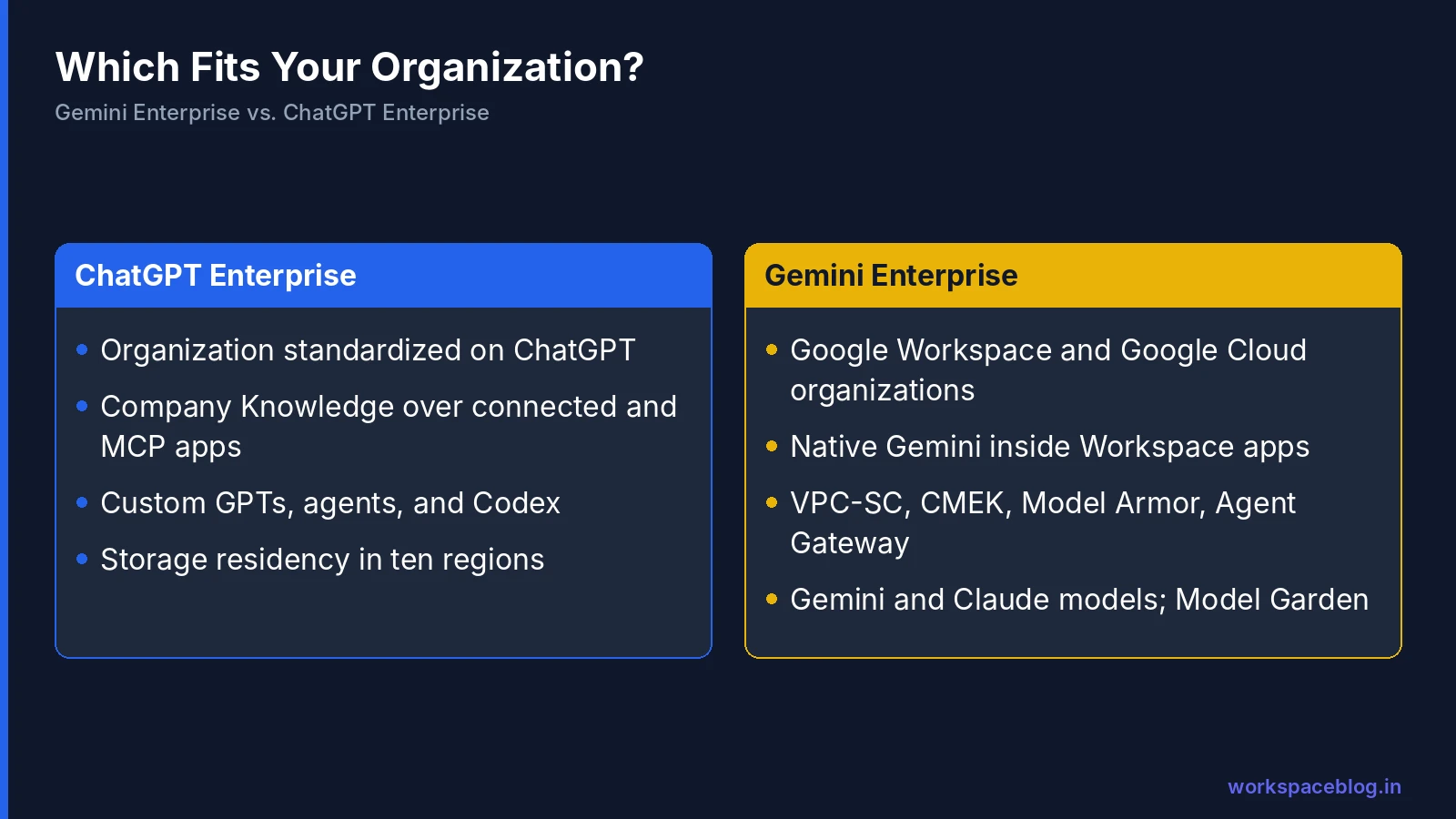
| Your situation | Likely best fit |
|---|---|
| Google Workspace organization | Gemini Enterprise |
| Heavy Google Cloud data (BigQuery, Cloud Storage) and custom agents | Gemini Enterprise |
| Strict data perimeter requirements (VPC-SC, CMEK, Cloud Logging) | Gemini Enterprise |
| Organization standardized on ChatGPT, little Google footprint | ChatGPT Enterprise |
| Need storage residency in South Korea, UAE, or Australia | Check ChatGPT Enterprise’s regions; confirm Google’s current list |
| Mixed suites, many SaaS sources | Test both; compare connector depth and governance |
Handling existing ChatGPT usage
If employees already use personal or team ChatGPT accounts with work data:
- Find out what they use it for: the use cases tell you what the approved tool must do
- Offer the approved platform with equivalent or better experiences for those uses
- Set a clear acceptable-use policy and a cut-off date
- Use your DLP and browser controls to discourage pasting sensitive data into unapproved tools
A Note on Lock-In
Whichever platform you choose, keep your investment portable where you can: write skills and prompts in plain Markdown, build tools as MCP servers, and expose custom agents over open protocols such as A2A. Those standards work across vendors, so a future change of platform means reconnecting rather than rebuilding.
Conclusion
ChatGPT Enterprise and Gemini Enterprise both deliver secure AI with access to company data, but they’re built differently. ChatGPT Enterprise is a strong, familiar AI workspace with connectors, custom GPTs, agents, and Codex. Gemini Enterprise is an AI platform woven into Google Cloud and Workspace, with deeper control over data stores, residency, encryption, network perimeters, and agent governance, and model choice that includes Claude.
For organizations on Google Workspace, Gemini Enterprise usually wins on integration and total cost of ownership. Whatever you lean toward, run a fair pilot on your own data and tasks, and choose one primary platform to govern well rather than two to govern halfway.
Official documentation:
- Gemini Enterprise product page
- Compare editions of Gemini Enterprise
- Company knowledge in ChatGPT (OpenAI Help Center)
- Data residency and inference residency for ChatGPT (OpenAI Help Center)
- Business data privacy, security, and compliance (OpenAI)
Related reading:
- Gemini Enterprise vs. Microsoft 365 Copilot: the other big comparison.
- Gemini Enterprise Data Residency, VPC-SC, and CMEK: Google’s compliance controls in detail.
- Gemini Enterprise Rollout Plan: 90 Days: deploying your chosen platform.
This guide contains referral or affiliate links. If you sign up through one, Workspace Blog may earn a commission at no extra cost to you. Read our referral and advertising disclosure.
Frequently Asked Questions
- What's the core difference between Gemini Enterprise and ChatGPT Enterprise?
- ChatGPT Enterprise is OpenAI's AI workspace for organizations, centered on ChatGPT with company knowledge from connected apps, custom GPTs, agents, and Codex. Gemini Enterprise is Google Cloud's AI platform: an assistant, permission-aware enterprise search, Deep Research, notebooks, and agents built on Gemini Enterprise Agent Platform, with Gemini also built directly into Google Workspace apps.
- Can ChatGPT Enterprise search Google Workspace data?
- Yes, through connectors. OpenAI's Company Knowledge works with supported connected apps (Google Drive among them) and custom apps built with MCP, and respects permissions in the connected source. It works from ChatGPT rather than inside Gmail, Docs, or Sheets, where Google's own Gemini features run natively.
- Which has more data residency options?
- OpenAI lists data residency for ChatGPT Enterprise and Edu in Australia, Canada, Europe, India, Japan, Singapore, South Korea, the UAE, the UK, and the US, with inference residency in Europe, the US, and the UAE. Gemini Enterprise offers global, US, and EU multi-regions plus in-country regions for Canada, India, Japan, Singapore, and the UK (with allowlist), and commits to ML processing in-region for base functionality, with feature-level exceptions.
- Which models do they use?
- ChatGPT Enterprise uses OpenAI's models. Gemini Enterprise orchestrates across Google's Gemini models and Anthropic's Claude models (Claude stays off until an admin turns it on), with Smart Routing choosing a model per job, and Gemini Enterprise Agent Platform's Model Garden offers more than 200 models for custom agents.
- Which is better for Google Workspace customers?
- For most Google Workspace customers, Gemini Enterprise is the more natural fit: it uses the same Google identity, connects natively to Drive, Gmail, and Calendar, and pairs with Gemini already inside Workspace apps. ChatGPT Enterprise can still make sense where teams strongly prefer ChatGPT or rely on OpenAI-specific tools, but it adds a second AI platform to govern.